Image
 They think that if they read my writing they know me, but I think that couldn’t be farther from the truth. -Maya Johnson

Just Another Unknown - A Self Interview

By Maya Johnson - October 17, 2023

What is the purpose of the Interview for you?

I suppose interviews are something reserved for people we find fascinating, a way to pick apart their brains. But I don’t think I’m particularly interesting, or at least well-known. Most smaller, more unknown artists never get the chance to explain their process or their personhood, but those are the ones I want to know the most about. The way that publishing works today, there are a million unknown writers with a million small publications scattered across the industry, but little to know record of who they are besides a short blurb. I want to get to know more artists before they get big, or get to know them if they never do, and I want more artists to get to intimately know themselves.

How do you relate the concepts of personhood and writing?

I think that unless you are famous, most writers do not have a personhood outside of their art. At least as writers. It is interesting, as you continue in this industry you start to get the feeling that who you are as a person can only be important if it's publishable, and that your personal experiences are only fodder for your writing. Oftentimes, through fiction we express our personal feelings and urges through character, but my characters are not me and my fiction is not my life. It’s very difficult to convince people of that. They think that if they read my writing they know me, but I think that couldn’t be farther from the truth.

How did you get into writing?

I always use this anecdote about my grandmother when someone asks about how I got into writing, about how when she was growing up in Mississippi, her mother had to make the choice to send her and her siblings to school or have work in the fields to feed the family. My grandma left home very young, and she’s lived such a rich, wise existence, but the shame she felt for her lack of education followed her. She always tells me that she wanted to be a writer.

In my family education was always situated in a place of high importance because of what my grandmother couldn't have. I love my grandmother, I’ve always revered her. I want to be what she could not.

One time I got upset with my older sister for being mean to me or something else that kid sisters do to each other, and instead of telling my parents I wrote them a letter. Put it in a sealed envelope and everything. This was in first grade and my parents still love telling that story. God only knows what compelled me to write them a whole fucking letter at like seven years old. I don’t know. I’m not very good at speaking. Maybe it was the only way I could communicate.

Is there a book or author that greatly inspired you to write?

Yes actually! There were so many books I loved when I was younger but they were mostly children's books, you know the kind you get from a scholastic catalog at school? Dear Dumb Diary, Harry Potter, that kind of thing. But my grandmother was—is—really into old British stuff. By middle school I’d seen Pride and Prejudice (the mini series not the movie, it has a lot more detail) enough times to memorize the lines. Grandma also really likes reading, you know she didn’t get to finish her schooling so she likes to educate herself in other ways. Anyways, she had a copy of Pride and Prejudice on her bedside table where I’d sleep when we spent the night and one night I started reading it to my sister. I guess because I’d seen the series it was a lot easier to get into Austen at a young age. She inspired me to write in a way I’d never considered before.

Is there a genre that you tend to write in?

Fiction would be the simple answer. Realistic fiction maybe? My older stuff was always very fantastical but lately I’ve been drawing more from my own life, trying to communicate the things that I’m seeing and experiencing rather than playing around in some imaginary world.

Do you feel as though your gender, ethnic, race, class or other affiliated identity influences your writing? If so, how?

Oh absolutely. I think about writers I’ve read recently across the African Diaspora like Toni Morrison or Brit Bennet or Nicole Dennis Bett. Yeah it’s fiction, but the content directly has to do with issues within the black community or that black women face, it's about making the reader see through your eyes. Same with queer writers. I think there are some writers who get the liberty to write without having to worry about how their identity influences their works in that sense. I am not one of them. When I write about my world I’m writing about systems of oppression without even trying, you know? All the things that I’ve experienced, all the things I’ve read and learned about just bleed into my writing, so the struggle is getting someone who is not me to care about what I, or people like me, go through. Sometimes writing becomes an act of activism without even trying. 

What is the most difficult aspect of writing?

Finishing a story. Making all the little working pieces fit together and feeling confident that you did it right. That it flows perfectly. That doesn’t need one more edit.

What is the best and worst writing advice that you have received?

“It’s hard to be creative. It’s so much easier to render.” This came from my fiction professor on the first day of class this quarter. That day I wrote one of the best stories I’ve written in a long time, effortlessly, and my writing since has transformed in a way that I think is really beautiful, so I’m grateful for this piece of advice. But, he literally tells us this every class, without fail, sometimes multiple times. 

Do I think rendering experience is useful? Yes. But that can’t be all you do, can it? For me it’s about balancing that with creativity and imagination. I’d feel like a fraud if I called myself a fiction writer but only wrote like someone like Dan Humphrey or Jenny Schecter, compiling tales of my closest relations, changing the names slightly, and passing it off as “fiction”. Besides, the friends and family of both those characters turned against them when they read their books. I’d hate for anybody in my life to feel exposed through my writing.

Is there a type of writing that you absolutely cannot stand?

I have no patience for writers who spend paragraphs or pages wandering around descriptions that add nothing substantial to the piece. When I write description or imagery I try to only write things that mean something to me. A random character’s intimate physical description, for example, usually means nothing to me. Too many writers nowadays will write things like “I was wearing a red, raw-hem Fall Out Boy t-shirt, a pair of ripped mom jeans, and black Doc Martens. My long brown hair was braided over my shoulder in a way that drew attention to my hazel eyes, light brown with specks of yellow that turned green in the light”—I can’t take it. Does that not read as so vain? And like self important? Like I don’t want the reader’s eyes inside my closet for half a page, I want them focused on the plot, you know? I feel like, as a writer, you should have more to show for than aesthetics.

What is the point of all this?

What is the point of writing, really? I’ve spent the last few years drowning in rejection and feelings of unworthiness surrounding my writing. We writers must put ourselves up for judgment again and again, defining our worth by the tastes of an industry we know is held in the palm of a white, patriarchal, archaic structure. We all begin writing for ourselves, about ourselves, and at some point end up endlessly trying to appease people we don’t even know. So what is the point? There is none.

Theoretically, I wrote this all for you, my imaginary audience. But really, I just wrote it for myself. I think that’s true for all that I write, and I hope it stays that way.

Read moreJust Another Unknown - A Self Interview

Image
Vol. 67 Call for Submissions

Vol. 67 | Call For Submissions

By Sasha Senal - July 15, 2023

Spectrum Literary Journal is currently open for submissions, and for Volume 67 we will be observing and transgressing binaries.

Spectrum is an annual publication of art and literature based out of UC Santa Barbara’s College of Creative Studies. For the past 66 years, the magazine has celebrated a spectrum of voices, genres, and topics reflective of the wide range of human experiences, from both new and established writers. We’re particularly passionate about work that defies, bends, or manipulates genre, and we welcome submissions of prose, poetry, visual art, and hybrid literary forms.


Thirty spokes converge on a hub
but it’s the emptiness
that makes a wheel work
pots are fashioned from clay
but it’s the hollow
that makes a pot work
windows and doors are carved for a house
but it’s the spaces
that make a house work
existence makes a thing useful
but nonexistence makes it work

- Lao-Tzu’s Tao Te Ching, Ch. 11, transl. Red Pine


This excerpt from the Tao Te Ching guides the theme of Spectrum’s Volume 67, along with the following questions: How do existence and nonexistence play in unison? What necessitates emptiness and the environments that shape it? What other dualities are observable? Additionally, what are the limitations of binarism and how can we transgress them? Some submissions might explicitly respond to Lao-Tzu's ideas or address the aforementioned questions, while others might disjoint structure and form as a testament to the transgressions we are seeking to publish. We urge you to come forward with stories that rupture the quotidian and shake free the tethers that restrain us from living as our truest selves. Even a glance that lingers too long can be a story of imprisonment or freedom (or some third thing). We look forward to reading what you have to say about this.

Please click here to familiarize yourself with our submission guidelines and to submit your work. Thank you!


Sasha Senal (she/her/they/them)

Editor-in-Chief of Vol. 67

Read moreVol. 67 | Call For Submissions

Image
Oliver Nash: "If you think about it in a metaphorical sense, a maggot is this sort of liminal creature. It's something that is in a state of about-to-become-something."

'A Liminal Creature'

By Mikayla Buhbe - October 10, 2022

By 11:30 AM, the May marine layer is just starting to burn off above UCSB’s infamous lagoon.

A cool breeze rustles the palm fronds above my head and wiry metal spokes distantly whirl along bike paths winding through campus. The sun is out and it’s a nearly idyllic day, or at least it seems to be from what I can tell by the view from my COVID isolation room. After five days of staring at the same miscellaneous hotel room art, it’s hard not to reflect on the drastic ways our world has changed over the past two years and how it may continue to evolve in the coming days. It seems a strangely fitting moment to interview Oliver Nash, author of "The Maggot," a fiction piece published in the sixty-fourth edition of Spectrum. From stagecoaches to climate change riots, "The Maggot" follows the development of an American town as it expands, withers, collapses, and transforms over the course of several hundred years, all alongside a giant maggot. As the ocean mist dissipates in the midday heat, Nash and I discuss second-person narration, eco-anxiety, and the constant state of evolution that characterizes communities everywhere.

My name is Mikayla, I use she/her pronouns, and I'm an editor for Spectrum Literary Journal. My first question is just a bit of the intro: your name, pronouns, who are you, general background?

In publishing, I go by Oliver Nash and my pronouns are they/them. I'm currently in my second year as an MFA student at the University of Alabama. I’ve worked as an assistant editor at Black Warrior Review, been on the visiting writers committee, and been involved with a few other campus graduate programs. I went to the University of Cincinnati for my undergrad, where I did an English Creative Writing track with a psychology minor. I've been writing since I was about eighteen years old and actually went into school for psychology, but I ended up switching into writing after I started taking a few classes and things like that. 

That's such an interesting background, the intersection of psych and creative writing. What inspired this piece? Is this something that's part of a larger project or is it a stand-alone?

I actually wrote "The Maggot" a long time ago and I definitely think I've improved a lot since I first wrote it, but I've always believed in the piece. I’ve been submitting it for a couple of years before Spectrum finally picked it up. I wrote the first draft of this piece in one of my first creative writing classes. We had been reviewing different tenses in stories and I was really intrigued by second-person stories. I wanted to write a second-person piece, but I also had this ethos when I first started out writing where I wanted to try very ambitious things knowing that I was probably going to fail at most of them. I felt a little bit behind because a lot of people that were really serious about writing had been writing since they were kids or teenagers, and I’d really only been doing it a year or two. I thought, “Okay I'm going to write a second-person story and if it’s going to be a second-person story, it will be about a community of people.” I thought it would be really interesting to write a story from the perspective of a community and who defines the “we” that the story is speaking from changes over time. In this piece specifically, it goes from a couple hundred people to a few million, then down to four people at the end. One of my classes was in this building that overlooked one of the football fields and every winter, they put this huge, white cover over the football field. It’s the same cover they put on every year and it's never cleaned. It had been up for years at this point and I had been looking out on it, this massive white dome, dirty and grayed and chipped. I had this thought one day as I was trying to think of a story where it looked like a giant maggot. I thought, “What if, similarly to what the white cover does at the university, a huge maggot showed up in a little community? What if it didn't do anything for the entire story?” The maggot is almost standing in for the reader as witness to this community growing and changing and shrinking over time.

I’ve been working on Spectrum for two quarters, so I've been thinking about this piece for several months. It's so interesting to hear the origins of it. I legally have to ask, since it came up all the time in our discussions, was there ever a moment where you considered if this creature could be something else? Is there a reason why the maggot, in terms of symbolism or representation, stuck with you throughout the piece?

It's one of those things where I had an idea of what it was all supposed to be about as I was writing it and, through later drafts, as I was really thinking about it, the different elements really started to coalesce for me. If you think about it in a metaphorical sense, a maggot is this sort of liminal creature. It's something that is in a state of about-to-become-something and it stays that throughout the whole piece, even at the end when it fully changes and we’re down to these four people, who find their new maggot at a gas station. To me, that's saying something about community in general and about the ethos of community that is represented in this piece. There isn’t necessarily a point to community and what defines it can change over time. It's morally gray. The maggot never hatches into something because the community just is what it is. There is no ultimate state of community, there is no point. It’s just that state of becoming.

You talked about it a little bit in terms of the second-person evolution of this piece, but this story has such an interesting relationship with time. It covers several hundred years in just about twenty pages. Why did you choose these time periods to focus on? Was there something specific about each time period that connected with the theme?

I was thinking about it partially in terms of the evolution, or common evolution, of an American town into a modern metropolis. Specifically, there's also a climate-change angle, which comes through in a lot of what I write. It is maybe not as present in this piece, but it was in the back of my head. We start in this very small, pre-industrial farming town and then the town gains an industry, and then it comes into the early 20th century, beginning to be post-industrial and entering World War I. Then on from there, we go into modern-day and then post-modern, almost post-apocalyptic-esque. I was following major economic points and major points in industrialization and development through time, and therefore, major points of different population sizes. I wanted to explore the community at vastly different sizes of people.

I’m wondering how the physical structure of the piece, the italicized intros and longer sections, informed your process of writing it? Was it always going to be structured like that or did that naturally evolve?

This is a piece where I definitely planned a lot, but when I put down the first draft, it was structured like this. I think this is probably the only piece I’ve ever written where I do these italicized intros and I'm sure it's something that I read in class that entranced me. I was dealing with the problem of, “Okay I want to try to make a story work over three hundred years in twenty pages.” The only way for me to do that would be to have individual little scenes. I figured if it was all just a summary, it would come off as preachy or didactic. It wouldn’t really be giving that visceral experience of being in a community or glimpsing into a really intricate community at several different points and feeling like you can get a grasp of the sense of the time, the zeitgeist at that moment. The italicized sections really solved the other side of that problem, which was getting a more summarized view of that whole area of time. They ended up being these very sense, impressionistic, montage-y views of that community in that time period. In earlier drafts, the last section, which I believe is by far the longest one, was a lot shorter. My readers in my workshop class as an undergrad said, “We really like how in the scene we are here and we really liked the characters.” If there's ever a modern point in the story, it is the last one. The rest of them are a sort of build-up. I gave that one more space. But it was definitely a chicken-or-the-egg situation. The type of story I wanted to write presented a weird problem and so the weird solution kind of came all at once to fit around itself.

Throughout this piece, several characters come and go with varying degrees of importance to the overarching narrative. Towards the end of the story, we really get a closer look at this group of four survivors. You mentioned that in the workshop process, people were intrigued by this group. Was the process of writing this smaller family group different than how you'd approached the rest of the story?

Definitely. I feel like I’ve gotten better at this over the last couple of years, but I think most of the characters in the early parts serve a plot function more than they are really developed characters. Especially in the first section, a lot of the people in the hamlet in the late 1700s feel a little caricatured. They’re representing archetypes of people at that time more than I think the story needed. Honestly, in that first section, they’re played for laughs a little bit. I was particularly excited to write about this small group of people and I remember that allowing those characters to be more than just parts of the plot came very naturally in writing scenes. Who they were and how they interacted with each other came very easily and I really liked that. In a way, those four people are a character. Their interaction, their form of community I think is the most successful execution of that in the piece. They felt the most like people and in a way, they're representing different reactions to this evolution. You have some people clinging to this older idea of community that the city represented, which is now gone. Then you have some people who see this small little group–this found family and found community through accepting each other's differences and accepting the little quirks. That is very important to me, as far as how I see human interaction. It’s really about finding people and letting judgment fall to the side. You can make community and find love anywhere if you're willing to do that. 

There are moments where that narrator sometimes seems closer to the individual people, other times a little bit closer to the broader story. How did the choice to have a second-person narrator fit in with this piece specifically?

I am a firm believer that the rules of writing are made to be broken, but everything you break has to be for a reason. I love ergodic fiction like House of Leaves that really messes with the rules of fiction, but it works because you're messing with it for a very specific reason. You're doing it for effect. You can, of course, take any story and rewrite it in second-person because that's trendy or that’s what’s interesting, but if it not does not align with what the piece is trying to do, you’re only going to muddy the waters. For me, if I wanted to write a second-person piece, I had to write a piece that had to be second-person. There’s a reason that most stories are in third or first, and it's because that is a much more natural way of telling stories. We really infrequently tell stories in second-person. When we do, they are almost invariably about community in some way. Who is included in that community, who is excluded, what voices take hold, in what ways can singular voices pretend to be the voice of an entire community. 

There seems to be a strong commentary on political and social change in this piece, particularly in relation to climate change. I noticed in your bio you mentioned eco-anxiety as an issue that you consistently tackle. Is there like a message or lesson you’d like readers to take away from this piece or is eco-anxiety a broader subject that you're interested in commenting on?

I hope I'm not so didactic that I’m leaving too strong of a message or a moral outrage thing. What I am trying to impress a little bit is exemplified in the turn where this apocalypse comes to the town, this is end with the military bombing the city out as climate change rages around them. When it comes to climate change, when it comes to eco-anxiety, the type of discourse that I really don't like is this apocalyptic discourse. It feels almost like a secularized religious view of disaster and of climate change in the sense that if we don't get our act together, the world ends. The language that is used does feel very apocalyptic to me and the way that I view it is that, ultimately, probably not. Just like the effects of humanity on the climate are inequitably distributed through the world and on different communities and nations, so too will its negative and knock on effects. Even if the world, or parts of the world, end or things change excessively, there still will be community. You can't rely on everything ending, this absolution. To me, it feels like when some people view the negative effects of climate change, there's almost this idea of deserved punishment for our actions, that it will wipe us out. What I want to show in this piece is that our species will have to live with those effects. You’ll still have your communities, even if things are irrevocably changed. There is no escaping that, which I feel like helps to make you feel like you have more of a responsibility, if you know that you might make the world terrible but your grandchildren are still going to have to live in that world. You don't get the simple ending of, “Oh, this is going to wipe us all out.”

This story ends on a somewhat ambiguous, but not necessarily pessimistic note. Do you view this story as a hopeful one?

In some ways, yeah. In a very drawn back sense, I think it is hopeful. But it feels, in reading this about climate change or reading this about discrimination or the negative effects of human beings on this planet, the story is not hopeful. It’s not saying that we’ll necessarily figure this out or that human beings will become better or that, even if we do solve this problem, we will become inherently better as creatures. But it is hopeful in the sense that not all is lost. More than likely, there will be human beings and there will be environment and there will be community no matter what, even if that changes. Sometimes, it's easy to think that our way of life changing or the world changing to where it's unrecognizable to us is equivalent to everything being lost, but it really isn't. If you were to show somebody from a thousand or two thousand years ago what the world looks like today, they would probably have a similarly panicked reaction to us imagining how the world could look in two hundred years, changed as much as it appears it might change. 


[Interview has been edited for clarity]

"The Maggot" is available to read in the sixty-fourth volume of Spectrum.
 

Read more'A Liminal Creature'

Image
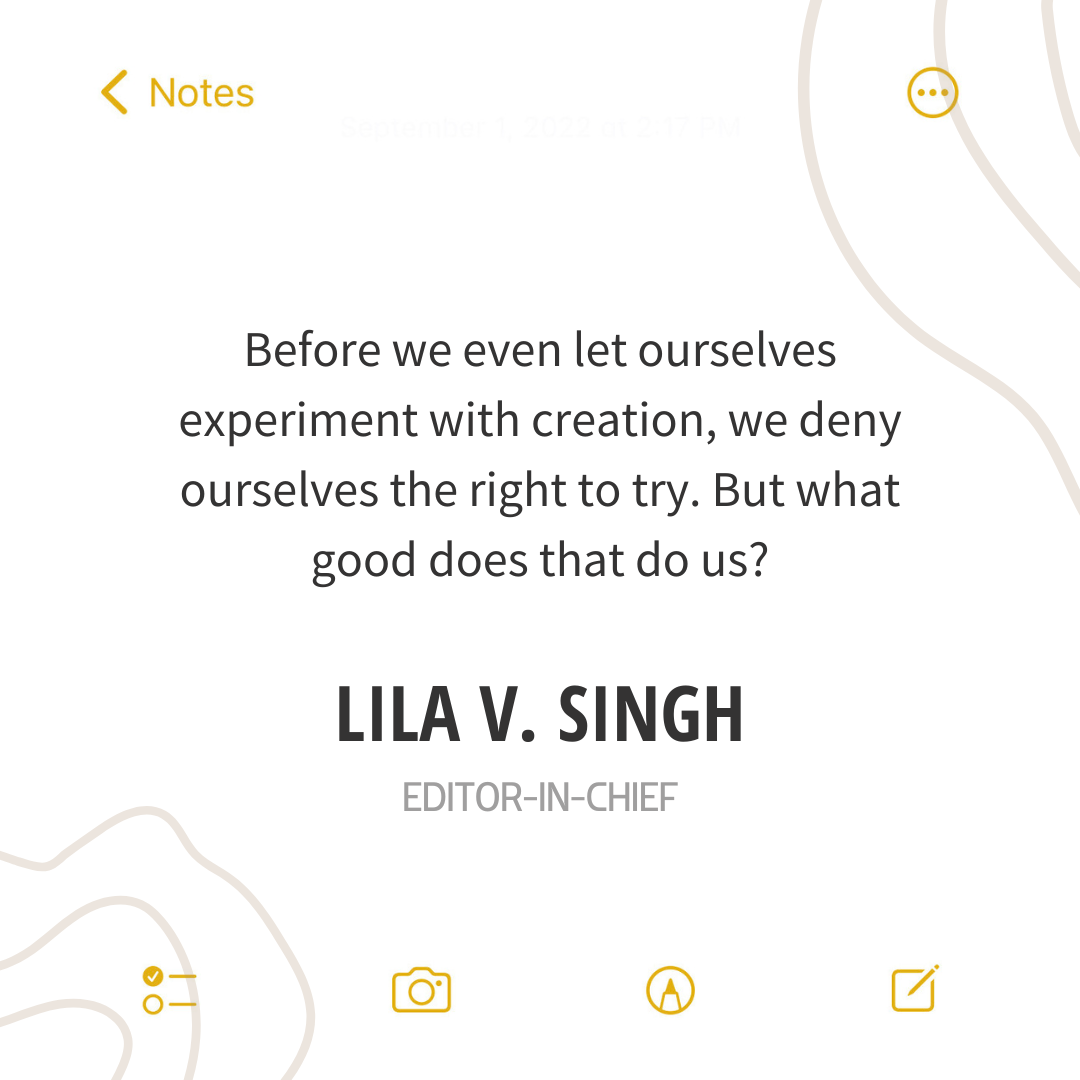
On a blank Apple notes page: "Before we even let ourselves experiment with creation, we deny ourselves the right to try. But what good does that do us?"

Take Note.

By Lila V. Singh - September 1, 2022

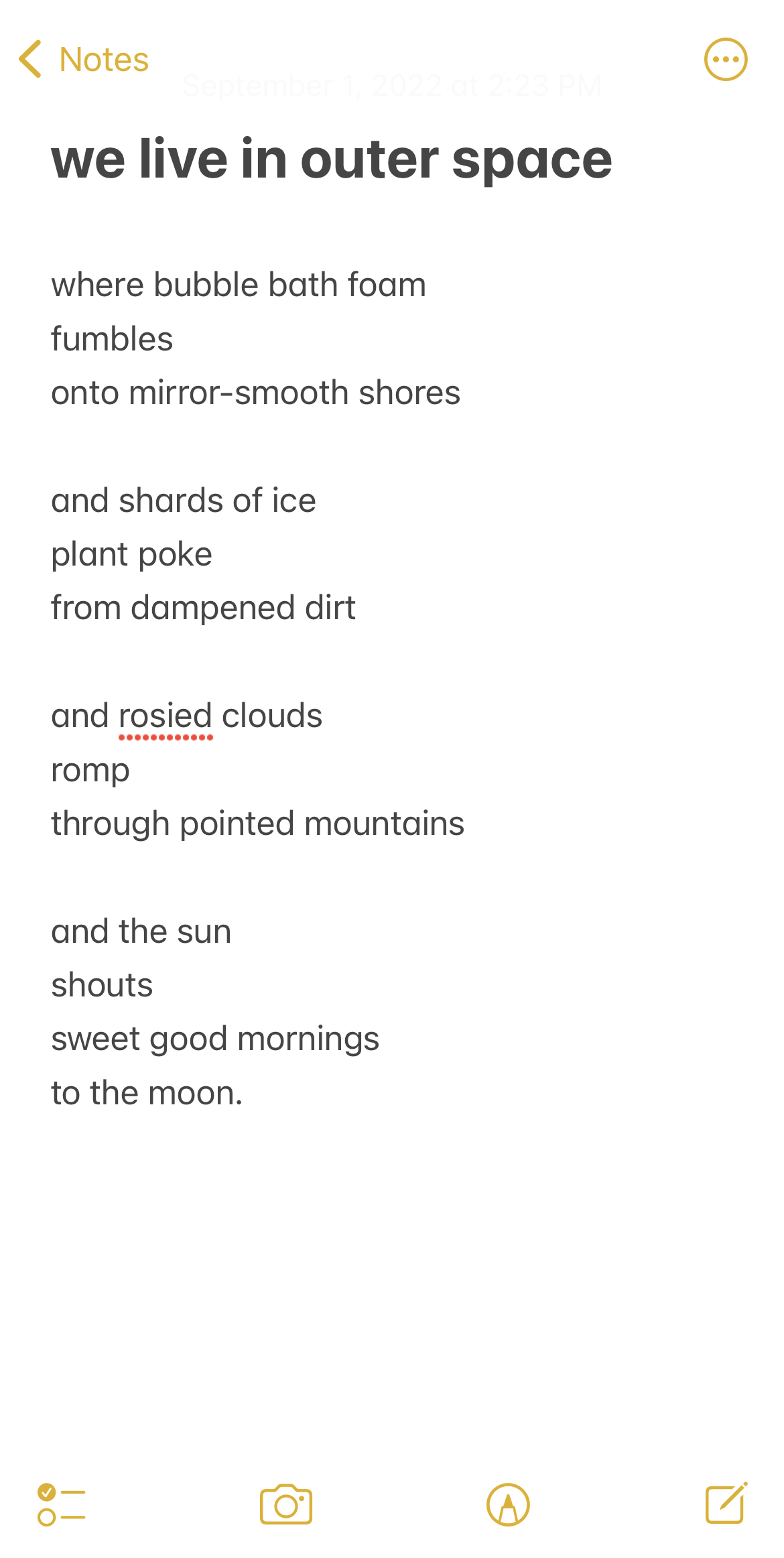
short poem written on Apple notes page entitled 'we live in outer space'

This is a poem written on my Notes app.

I won’t pretend that I think it’s a particularly “good” poem, at least by the criteria that I’m not sure I’d publish it if it crossed my desk. But, the point of this poem was never to be “good.” If it were, it would have graduated from my Notes app far sooner than my writing of this post. No, I wrote this poem because I was out for a walk in the quiet morning streets of my home—the seaside community of twenty-somethings known as Isla Vista—when I was stilled by a sudden appreciation of the natural beauty of where I live. 

Walking alone in the salt-scented morning air, my eyes flitted to every interesting shape around me—the jagged palm trees above my head, the faded triangles of the Channel Islands disappearing into the rectangle of the ocean, clouds like splashed paint in the blue sky—while my ears tuned into the local birds and their morning gossip. I smelt the kelp beached by sea foam under the bluffs and felt the warm sunlight on my nose juxtaposed with the coolness of the morning. 

Then, I noticed the moon still up in the sky, a white smudge, and was reminded of the fact that I’m just a tiny human on a planet in outer space; and I thought about how wild it is to be a creature so small in a universe so big; and I thought of all the ecological forces that combined to create the picturesque environment around me. I felt a sudden fear of losing the expansiveness of all these thoughts, which is why I pulled out my phone, tapped on a little white-and-yellow icon, and jotted my thoughts in my Notes app.

That translation of experience and observation into art—visual or written—is how I define what it means to create. The most beautiful thing about creating, in my opinion, is that anyone can do it. By virtue of being a human being on this planet, you’ve developed your own way of processing and understanding the world; creation is just a way of translating this perspective into a new medium, of bringing your observations from your mind into an outward expression, be that music, dance, painting, or writing. 

But in my personal experience and in conversation with others, there seems to be a misconception about who gets to create. I’ve been in many an art class where a frustrated student will set down their pencil in defeat, remarking “I can’t draw.” I’ve been at many a party where someone stands stiff-shouldered because, “I can’t dance.”  I myself often say, “I can’t write poetry.” On the surface, these claims come from a fear of not being able to create; implicit in each of them, though, is a fear of not being able to create well. We do not fear our ability to conceive things; we fear our disappointment in what we will conceive. 

Our fears can be linked to two things; the first is a hyperfixation on the products of creation. Rather than focusing on the enriching process of creating art, our minds have a foul tendency to default to anxieties about the art we will create. Sometimes before we’ve even touched our pen to paper or tried to move our bodies or held a viewfinder up to our eye, we talk ourselves out of our own capabilities. We fear that what we write or how we dance or the photo we take will be ugly. Due to real economic dependency on our art or capitalistic pressures to create artifacts with value, we become so concerned with creating something other people will be interested in that we, at best, create art which is a limited expression of ourselves and, at worst, do not create at all. 

The second basis of our fear is comparison. Out for ice cream one day, we borrow some of the paper and crayons set out for children, and draw a series of ice cream cones, as we see them, to the best of our abilities. Then, we notice the Wayne Thiebaud paintings on the wall, look back at our own dinky crayon ice cream cones, and feel a profound embarrassment. My drawing looks nothing like that, we cry, and whatever pride we had in our crayon ice cream cones evaporates. The joy we found in creating the drawing is gone. We’ve seen a “better” representation of ice cream, and we give up. Why even bother creating when there are other people out there who will create better things out there than me? Why even try creating when I’ll never be as good as [insert artist name here]? 

Obsessed with the quality of our creations relative to the creations of others, we create standards for ourselves that we demand our art lives up to. Intimidated by these standards, we either struggle unnecessarily with the act of creation or refuse to create at all. Before we even let ourselves experiment with creation, we deny ourselves the right to try. 

But what good does that do us? 

Create! Creation, remember, is for everyone. What are you waiting for? Make some art! Write lousy poems and give them to your friends. Draw trees you see while sitting in the park and laugh at how different your trees look from the ones you see. Write stories that dawdle through your imagination and don’t worry if the characters are cheesy or the plot shoddy or the prose bland. Forget about the quality of what you are creating, and focus instead on enjoying the process, the opportunity to challenge yourself to translate what you experience into another form. If something other people find beautiful comes of it, great! If not, still great! Remember—you are not creating for clout; you are not trying to make something that is perfect; you are not trying to be good. You are creating because you have a way of representing and conversing with the world that is distinctly yours and that is beautiful because of that. Do not let fear talk you into hiding that perspective from the world.

So go on a walk. Bring your phone. Open your Notes app. Have fun!
 

Read moreTake Note.

Image
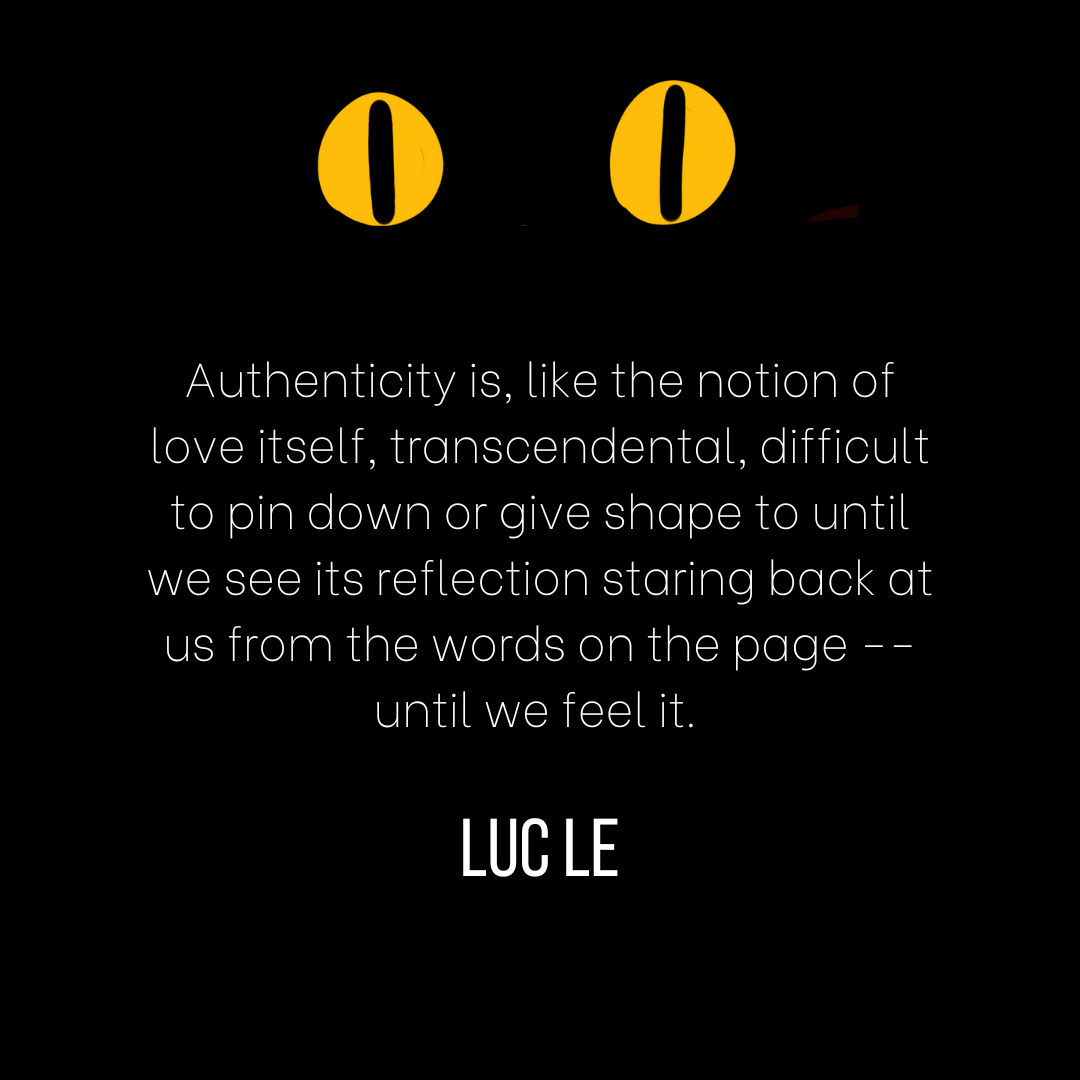
Luc Le: "Authenticity is, like the notion of love itself, transcendental, difficult to pin down or give shape to until we see its reflection staring back at us from the words on the page -- until we feel it."

This is An Essay About Aesthetic Value

By Luc Le - August 12, 2022

The first time I watched CATS was on January 1st, 2020. 

I was terribly hungover (as is typical the day after New Year’s Eve) and my best friend had just hours earlier puked an entire bottle of my parents’ terrible homemade wine (no, I will not be providing more context for this) into, rather inexplicably, his laundry hamper. There we were in the theater, $20 popcorn in hand, not knowing much about the film beyond what we’d heard from the reviews, which all seemed to include some combination of the words “bewildering” and “horny.” 

What followed inside that (oddly packed) movie theater was more akin to a religious experience than a cinematic one. As one, we gasped as feline Rebel Wilson unzipped her skin and swallowed cockroaches with the faces of children whole. As one, we screamed in terror as cat Jason Derulo screamed “MILK!” and tried to suck toes. As one, we attempted in vain to hide our tears as cat Jennifer Hudson, snot running rampant down her face, belted out one of the most inexplicably heartbreaking solos ever put to film. And as one, we stumbled out of the theater in a dazed silence, trying in vain to comprehend the magnitude of what we’d just witnessed. Finally, I spoke.

    “Well,” I said. “At least the rest of 2020 won’t be worse than that.” 

The second time I watched CATS was January 2nd, 2020. 

I had basically dragged my friend Peighton to see the film, partly because I wanted to see her reaction to it and partly because apparently the only thing I enjoy more than awful movies is making other people suffer through them as well. Midway through, I looked over to see her frantically stuffing a CBD-infused chocolate bar into her mouth. She looked at me, eyes wide with terror. 

    “I can’t be sober for this,” she whispered. 

As we walked out of the theater, I asked her what she thought of the movie.

    “I don’t know,” she said. “I closed my eyes for most of it so I wouldn’t have it in my memory.” 


CATS is, by most metrics (Rotten Tomatoes, IMBD scores, the opinions of those of us blessed with the gift of sight), an absolute fucking catastrophe. The “plot” almost entirely consists of horrible uncanny-valley cat people singing songs about themselves and then being zapped out of existence by horrible naked furry Idris Elba, half of the CGI is just straight-up unfinished, and the last ten(!) minutes of the film is just horrible cat Dame Judi Dench monologuing to the camera about why cats are not dogs. It is genuinely unbelievable that a major studio decided that this film was okay to release for actual people to watch. It is an affront to God and nature itself. 

So why do I love it so much? 

Trying to determine the reasons for one’s aesthetic values -- determining why we love what we love — is, in my experience, quite a difficult exercise. Love itself resists description and logic — that’s why we have poets, after all: to try, through some alchemy, so put the unexplainable into language. We may be able to give reasons for why we love something or someone —  the story has great images of nature, we might say, or they have wonderful hazel eyes, but rarely can we explain these in a way that crosses the barrier from superficiality. Why do images of nature connect with us so strongly? What is it about hazel eyes? It’s hard to pin down (unless you’re Freud, in which case it probably has to do with one’s attraction to their mother). It’s just something about them, we might say. It’s the je ne sais quoi (translation, French: “I don’t know what”). What kind of art appeals to me? In the immortal (and legally nonsensical) words of Supreme Court Justice Potter Stewart as he attempted to define pornography in Jacobellis v. Ohio, “I know it when I see it.”

All of this is to say that I’m really not sure why I enjoy CATS -- or, for that matter, anything that I enjoy. This is a rather unfortunate realization, given that I’ve spent over two years as an arbiter of what pieces are selected to grace the pages of Spectrum — you’d think I’d know what I value by now. Yet looking back over the films, television shows, books, games, gesamtkunstwerks that I’ve loved over the years, no clear pattern emerges. I’ve fallen in love with unfathomably pretentious international art films (Pasolini’s Edipo Re, anybody?), but I’m also the kind of person that has just finished their umpteenth rewatch of New Girl.  I claim to crave originality and hate art that feels like rubber-stamped products, yet I’ve seen nearly every one of Disney’s Marvel movies, in all of their comfortable corporatism. And time and again I’ve proven that I’m a sommelier for literal, actual garbage (see above). Perhaps part of the difficulty comes because of the simple fact that people themselves are varied and contradictory. To attempt to narrow down a person to a set of aesthetic values runs the risk of simplifying a person far beyond accurate description. What’s that cliche Whitman quote again?  “Do I contradict myself?/Very well then, I contradict myself/I am large, I contain multitudes.

But let’s try. That is the assignment, after all. Why do I love CATS? It certainly isn’t because of its use of language, given that large parts of it are in literal gibberish. It’s not because of the music, or cinematography, or plot —  the quality of which range from ineffective to nightmare inducing. And it’s certainly not because it is perhaps the most corporate movie ever made, itself an adaptation of a legendary Broadway musical, stuffed with stars from Taylor Swift to Idris Elba, armed budget in the hundreds of millions, an experienced director of musicals and a Christmastime release date designed to push it into the spotlight. 

It is, I think, because despite everything that surrounds it, despite all of the meddling and sanitizing that so often plagues storytelling on this scale, CATS is never under any illusions about what it is — despite the fact that what it is, for the length of its excruciatingly long runtime, is hairy and terrifying and incredibly, irrevocably horny.  CATS isn’t trying to play it safe, to moderate its weirdness for the mass audience Universal Pictures counted on it to attract. It is authentic at all costs — but especially at all costs. And I think there’s something to be said about pieces of art like that — the ones that refuse convention, categorization, and marketability, the ones that approach storytelling and language from an angle that nobody asked for. And yes, pursuing authenticity over all else does occasionally result in a car crash — as they say, sometimes you shoot for the moon and end up in Waco, Texas. But in the fiery wreck that is CATS I think you can just about make out, amongst the fur and felines, the purest form of artistic visualization, unsullied by corporate pressure or common sense or good taste or shame. These are the kinds of pieces that I want Spectrum to publish (well, maybe not CATS per se) — the ones in which I feel as though I can see the author’s face in between the lines. To me, that matters more than a preference of genre or language. Authenticity is, like the notion of love itself, transcendental, difficult to pin down or give shape to until we see its reflection staring back at us from the words on the page — until we feel it. How do I know what pieces I like? I know it when I see it. And what I see, in the strange, the absurd, and the wholly, uncompromisingly original, is something beautiful. 

Read moreThis is An Essay About Aesthetic Value

Image
Welcome to Vol. 66

Vol. 66 | Call For Submissions

By Lila V. Singh - July 1, 2022

Hello, writers and artists!


Spectrum invites you to submit your writing, art, or anything in between to be considered for inclusion in our 66th volume.

We welcome your weirdest and cherish your not-weirdest. Send us that story you have lovingly developed. Send us poems that take us out of our busy everydays because they demand we be still, demand we listen. Send us art that translates the experiential into the visual in ways we've never seen before; essays that leave us wondering; and works that blend, complicate, or transcend genre. Send us art and writing that represents some part of the broad spectrum of human emotions and experiences.

Our reading period for Vol. 66 opens July 1st and closes December 31st. We accept poetry, prose, art, and hybrid pieces.  Learn more and submit here.


--Lila V. Singh, Editor-in-Chief

Read moreVol. 66 | Call For Submissions

Image
test

Announcing the Spectrum Vol. 65 Launch Party

By Spectrum Editorial Staff - May 23, 2022

Dear Spectrum Readers,

On behalf of the Spectrum Literary Journal editorial staff, we'd like to cordially invite you to the launch party of Spectrum's Volume 65! 

Come join us on June 3rd from 5–7 pm in the College of Creative Studies Old Little Theater (located on the UCSB campus) or virtually on Zoom for an evening of literature, snacks, and community. The event will feature a selection of readings from Spectrum contributors, as well as the announcement of the winners of the 2022 CCS Writing Contests. 

Masks are required for the indoor portion of this event, and journals will be available for purchase for $10 (cash or check).

Please RSVP using this link, and email ccs-spectrum@ucsb.edu with any questions.

We hope to see you there!
 

Best regards,

The Spectrum Editorial Staff


Read moreAnnouncing the Spectrum Vol. 65 Launch Party

Image
bob krut

Robert Krut Only Sees Ghosts

By Luc Le - November 19, 2021

I first meet Robert Krut (or, as he’s been signing off on his emails, Bob) over Zoom, on a sunny afternoon in Isla Vista, California.

Not that location, or weather, or time really matter over video call. But it’s hard not to notice the sounds of activity on the bustling college town streets —the chatter of passerby, the ringing of bike bells, the distant crashing of waves into the shore. Sound travels oddly here, even in the best of times; the buildings are only a few stories high and the walls tend to be thin, so it’s not uncommon to hear conversation (or, if it’s past sundown, hoots and hollers) of twenty-somethings from streets over. When the pandemic hit, the streets fell eerily quiet. But now the music of the small town sounds around UC Santa Barbara are louder than ever. Which makes it all the stranger that we meet trapped, once more, within the confines of a Zoom chatbox. 

But strange has been, for the better part of two years, the operative term. Even as the world roars back into operation, vestiges of the pandemic continue to sneak their way into everyday life. Case in point: the loud, glitchy Zoom call we find ourselves in on a sunny coastal California afternoon.   

We’re supposed to be here to talk about poetry. We’re here to talk about Krut’s fourth poetry collection, Watch Me Trick Ghosts, which was written over the course of the pandemic. But the eccentricities of technology, as ever, have decided otherwise. My colleague, Lila, is having technical issues. Her internet is bad and her laptop dying, which manifests itself in her audio cutting in with the loud crackling of surrounding conversations (she’s stationed at a campus Starbucks), or her dropping the call completely.

The first time she drops, it interrupts Krut mid-sentence. “Whoops,” he says, with only a bit of resignation in his voice. “Maybe that’s a sign I’ve been talking too long.” 

He’s used to it. We all are by now. Strangeness has become a way of life. Perhaps even more so for Krut, who, besides his work as a poet, has taught as a continuing lecturer in UCSB’s Writing Program and College of Creative Studies for the better part of two decades. A student's glitching call, then, is nothing new. Strange is the operative term, yes, but how strange can a situation be if it’s happened time after time? How strange can a routine of strangeness truly be?


Indulge me, if you will, for a brief discussion of Russian formalism (it will be short, I promise). In 1917, literary critic Viktor Shloksvy coined the term “defamiliarization” (or, as some have called it, “estrangement”), in his essay “Art as Device," defining it the process of describing the world so that “its perception is impeded and the greatest possible effect is produced through the slowness of the perception.”  In layman’s terms, it is the process of making the familiar unfamiliar through language, the transformation of the mundane into the sublime, the bizarre, the uncanny. Art removes us from time, unsticks us from habit, from the automation of daily routine. And it is, if we are to take Shloksvy at his word, the core labor of being an artist. But how does one perform this act of transmutation when there is no longer any kind of familiarity for one’s language to push off of — say, during the chaos and uncertainty of a pandemic? How can strangeness be expressed within art when strangeness itself is now routine?

Such is the problem that recent pandemic art has often found itself within. Over the last submission cycle, Spectrum received many Covid-centric submissions. Nearly all of them were rejected. The impulse to write on the pandemic is understandable —in its reshuffling of everyday life, the pandemic seems so fruitful for content, so ready to be mined for subject matter and theme and story. Yet in their attempt to recreate the feelings of the ordeal to those already experiencing it, there is some essential strangeness lost, and thus these submissions failed to capture either the authenticity or complexity of the ordeal. We see right through them —as the Atlantic writer Lily Meyer writes, pandemic art “relies on the ability to channel inner experience outward, and because no inner experience of the coronavirus pandemic could plausibly be described as complete, prose that renders it static and comprehensible rings false.” 

Watch Me Trick Ghosts is not, at least on the surface, a collection about the pandemic in particular. There are hints of its origin sprinkled throughout: the first poem, “The Dinner Party," describes a cathartic gathering over Zoom; another, “The Branch” begins with the line, “There is too much death and rain this year.” We are taken on a journey through abandoned streets and office buildings and forests, seeing ghosts and lighting and bodies —so many bodies. Ribs and hearts and bones and blood. Yet the spirit of the pandemic remains ever-present. Grief appears and reappears, the way that grief does. The walls of a room “hold a grudge.” Krut wrote nearly the entire collection during quarantine, confined to his home —as he says, “We were in our house, and that’s what I was writing from. In general, this was about just sitting down and seeing what comes out of the subconscious.” 

In this sense, Watch Me Trick Ghosts can almost feel like a journal, or a record-book of sorts: fifty-four pages of collected images and emotions that mark the journey of a mind through quarantine. For Robert Krut, poetry has always been about the process of observation. “It sounds corny,” he says, “but traditionally what happens for me is I see something or I’ll hear something and something about it jumps out and that will be the spark.” And almost always, Krut says, that spark finds a home in the ever-trusty Notes app, home not only to the drunken, to-be-deleted-in-the-morning ramblings of teenagers, but apparently also the observations of an accomplished and acclaimed poet.

And the 40-something poet and professor certainly has seen plenty to spark a poem, from his childhood in New Jersey to the multicolored and jumbled streets of his Los Angeles home to the beaches and bluffs of the Santa Barbara campus. So it makes sense, then, that during a global pandemic, when all the usual candidates for observation are gone, when shops are shuttered and the sidewalks deserted and our collective existence is defined by those ever-prevalent stay-at-home orders, that Krut’s answer was to turn towards the worlds of the interior: the cavernous interiors of abandoned buildings and the suffocating stillness inside of doors and windows and walls, but also in examining the strangeness and horror of the human body itself. 

There is a certain vagueness (or, in another sense, universality) here —proper nouns are rare, and the scenes of Krut’s poems tend not to name specific places or people (though the images are nonetheless extremely precise). But such is the artist’s task —to, as Anais Nin writes in The Novel of the Future, “shake up the familiar scene, and as if by magic, we [are made to] see a new meaning in it.” 

And so, like a magic trick, Krut makes it feel strange all over again. The image of a man walking his poodle in “Give Up” is a “walking corpse.” A vein in “Gravity of Numbers'' is “an unplugged wire with frayed ends.” Drops of rain soaking a leaf in “The Branch'' are “a hundred shocked eyelids.” Surrealism is the tool of choice here; a lifelong Angeleno might be able to spy hints of the city in the glow of street lamps in “Tourniquet Road," or “the city’s finest amblers'' in “The Blood of Human Kindness," but just as soon as we begin to recognize the familiar, the scenes twist in on themselves, revealing the darkness within. In Krut’s hands, the mundane becomes the surreal, the ominous, and the horrifying, not in spite of their mundanity but because of it. Reading this collection often feels like staring at your hand for long until it no longer resembles a hand, until it is something alien and distorted and terrifying and yet trapped with you all the same. It is, then, a rather perfect representation of the cognitive estrangement quarantine inflicts, leaving us with nothing but the body our brains are attached to and the existential dread of the next day’s coming disaster.  


For his part, Robert Krut does not seem like the type of person who spends his days thinking about “the orange walls of the room that hold a grudge,” or “the implication that noise equals bloodshed.” Not that these qualities are easily observable from a Zoom box, anyway. Over the course of our conversation, he speaks with the personable nature, good humor, and infectious enthusiasm of someone who’s spent the majority of their adult life interacting with students. Indeed, it’s through his relationship with students where Krut finds much of his creative mojo: “I always wanted to be a teacher,” he says, “so my work as a teacher is both out of love of teaching -- but also, selfishly, it's invigorating.” 

Krut tells me that his working with students plays a major role within his writing process. Over last year’s online-only academic year, Krut taught several “tutorial classes”, where a small cohort of students shared work and discussed the intricacies of poetry together. Such is the unique nature of working at UCSB’s College of Creative Studies, a small, graduate-like program that houses a few dozen of the university’s most dedicated and talented writers (and which, full disclosure, produces Spectrum Literary Journal). The lines between mentor and student are not so easily drawn here —which, at risk of the theme here becoming stale, is, compared to almost all undergraduate writing programs (or college programs in general), rather strange. Instead of the formality and bureaucracy of a traditional college major, the Writing and Literature major aims to foster a more collectivist atmosphere, with students often working alongside their professors rather than simply submitting work to them. Those that study in the CCS are not simply students —they’re considered artistic collaborators as well. As Krut says, “These past couple years really reminded me of the idea that we’re all working together —the idea that [they’re] sharing work with me but also I’m trying to share work with them as well.” 

And for Krut, leveraging this relationship proved incredibly fruitful when developing this collection. “It made such a difference on the writing of this book because I would be working with other people who were all great writers —and yes, they were students, but they were also great writers. So we would talk for a couple of hours each week about poetry and I would end the Zoom and I would want to go write.”  And this collaborative atmosphere that CCS provides, Krut says, is one in which even the most experienced writers feel more comfortable sharing and developing their most authentic and challenging work. The best poetry, he says, is the kind in which poets are “willing to go right to the edge” —to face the tension of, as he says, “tipping into the melodramatic or the cliche.” But, then again, “You have to go that far to do anything that’s worthwhile.”

It’s not hard to see this type of risk-taking within Watch Me Trick Ghosts Here. There is a striking directness to Krut’s use of metaphor in this collection — which is, Krut, says, is very much by design.

“Something that interested me when working on this [collection],” Krut says, “was that if you use metaphors, it can become very heavy-handed —it can be overdone very easily. And instead of tiptoeing around it, I just wanted to say, here it is. Just put it all out there.” As “A Coffin is a Battery” says, “Subtlety is a gift for the privileged.” And in the time of the pandemic, it’s a gift that art cannot afford. 

This frankness is part of the reason that Krut specializes in poetry. He has written —and taught—fiction and creative nonfiction in the past (he applied under both fiction and poetry for his MFA at Arizona State University), but the poetry’s ability to be more concentrated, more direct, makes it his preferred form. “What I want to provide is very concrete images.” Krut says. “Even if they’re surreal, there are these grounding elements, these kinds of pins in the poem that keep us focused. And then hopefully they’re the kind of images that people can see themselves within, so it’s more of an interactive experience.”

Such is the power of this collection —while the scenarios presented dip into the surreal and the horrifying, we can still find ourselves quite easily between the lines. While Krut’s words deconstruct the familiar and everyday into the otherworldly, there nonetheless remains a sense of tangibility, a touch and feel to ground us within the bizarre. There is quite a bit of physicality running through many of the poems in Watch Me Trick Ghosts (not surprising, considering its pronounced focus on bodies), from “ghosts who trace our bodies with a hundred fingertips”, to “a barked face comma wrapping your chest). But often the surreal scenarios are presented in a direct, almost matter-of-fact tone, which works to both tie us to each scenario, yet amplify the estrangement of the weird and wild imagery. The portraits of “marbled meat” turning to bone, or the skin’s “rope burn tattoo”, or one’s “convicted ghost twin” seem all the more peculiar when each narrator presents them to us in such a matter-of-fact manner, as if they might simply be a part of this new everyday. In a world as twisted and fractured as our own, what was once strange is now familiar. 

Which, as Watch Me Trick Ghosts shows, makes it all the more bizarre. 


The popup that covers the faces on our screens interrupts our interview again. 

It’s an automated missive from the Zoom gods, telling us our allotted 45-minute call time is almost up. Just a reminder of the strange middle ground we now occupy, two years into the pandemic. One foot in the sunny SoCal streets and another in the isolated world of the interior. It’s cleared away without any fanfare: no acknowledgement of its oddity, only its existence.

Which means something, I suppose, to the poet’s eye, amongst the college town and classrooms in the shadow of the Santa Ynez mountains. 

“Anyway,” Robert Krut says, clearing his throat. “I’ll just wrap this up.” 


Watch Me Trick Ghosts can be purchased from Codhill Press.
 

Read moreRobert Krut Only Sees Ghosts

Image
image of pencil

To Create — And Not Just for a Paycheck

By Levin Fetzer - October 15, 2021

When I was in first grade, I wanted to have a Writing and Books themed birthday party.

I remember sitting in my sun-filled playroom, four or five close friends around me, a marker in my hand and my tongue between my teeth as I scribbled the few words I knew how to spell correctly (and many more that I did not) onto a blank page. The joyful creation that is Wonderland was real, and the friends at my house were wonderfully mad guests. We weren’t worried about word count. We weren’t worried about writing for someone else. We weren’t even worried about whether the words we wrote were spelled correctly, or even real. We were writing because we loved to write. I loved the feeling of making words appear on a page to go on to create something entirely new. I loved the feeling of taking myself away from the present and into a world that was entirely my own. 

As creators, we are told that we must create, and that what we create must be marketable, sellable, profitable. It is only through our craft and art that we can succeed and officially call ourselves a creator. If we don’t find our work published, then we’re not actually a creator. Or, at least, that’s the narrative that is spoon-fed to us by society. In a world that is ruled by capitalism, it is of the utmost importance to publish work and reap the benefits from it, no matter how small. The end goal is always to produce, produce, produce. We are told to “think about the audience”, and “write/draw/paint/sing/dance for them”. There’s no such thing as having our craft be private, because if there was, it would be considered a waste of time. Art has to be for the People At Large, rather than just for the creator themselves. I sometimes wonder: why bother putting time and energy into writing a piece that no one but myself is going to read? What’s the point of being an author, if the world is already filled with more books than people (and we’re moving away from books, anyway)? Why am I even trying? 

That, of course, is a vicious thought spiral that ends in dread, apathy, and depression. There’s no help in going down that rabbit hole, yet I go down it nonetheless, always searching for the bottom of the pit, and for a Wonderland that never comes. 

The downward spiral always starts the same: I’m looking back over old pieces of writing, wondering why on earth I ever thought they were worth spending hours to create them. 35,000 words, and every single one of them absolute crap, I think to myself as I scroll over the pages that made up countless sleepless nights. And then the thought comes in: What’s the point? Because there is a point. There has to be. 
Right? 

But what if this wasn’t the end goal? What if, instead of there being an end goal, writers were able to just write, singers were able to just sing, painters were able to just paint, and dancers were able to just dance? What if, instead of working for the People At Large, we worked for ourselves, for our own pleasure and enjoyment? What if we were given free rein to simply create? 

Maybe I’m mistaken, but I don’t believe I am the only creator who feels pressure to create. Assignments, deadlines, word counts, formatting— it is all superficial. There is so much more to writing (and creating in general) than these tools used by society to pressure us to create for the People At Large. 

As a writer, I know how it feels to try and meet word count goals, to try to create pieces that will be palatable for the People At Large, to feel pressured into making something that fits into the boxes that society gives us. For myself and likely countless other creators, the block and anxiety that comes from staring at a blank canvas or sheet of music or page is largely due to the fact that we want our work to be publishable. It’s not the fault of our creative minds that we get stuck in the endless, spiraling rabbit hole, but rather the fault of a society that is constantly pressuring creators to create. 

But let me ask you, the reader (potentially an artist yourself), a question: when you were a child, did you create out of profit? Or did it simply spark joy? Children do not create because they are wanting to get paid for their work; they create because they enjoy it, because it makes them feel good, because they love falling in love with the act of creating. Why can’t art be like that for everyone, regardless of age? 

There is some irony to me writing about this topic for a blog post that I know will be published; believe me, I know. But believe me, too, when I say this: I am trying. I am trying to create outside of school, outside of assignments and deadlines and word counts and formatting. It— like the rest of me— is a work in progress. It will take time before I feel comfortable writing just for me. But I am getting there. Slowly but surely, the dread, apathy, and depression are fading, and the spiraling rabbit hole is becoming easier to side-step. 

I will reach Wonderland. But I don’t need to fall to get there. 
 

Read moreTo Create — And Not Just for a Paycheck