Image
shipwreck

Contributor Interview: Lee Huttner

By Belle Machado - May 31, 2021

Belle Machado, Spectrum managing editor, interviews Lee Huttner, writer of the essay "The Wrecking Ground," published on our blog.

1. What inspired you to create this piece?

“The Wrecking Ground” was inspired by Henry Thoreau’s 1850 journey to Fire Island, at the bequest of Ralph Waldo Emerson, in an attempt to recover the body of Margaret Fuller, who died in a shipwreck off the island’s shore. It’s an event not many people know about, and such a serendipitous triangulation of well-known American writers—Emerson sending Thoreau down to find Fuller—one of those truly “stranger than fiction” moments in history. The image of Thoreau standing at the shore, looking out onto the Atlantic, waiting for a body to wash up, stuck in my mind since I first learned about the event years ago. Digging deeper into it all, I found myself increasingly fascinated by this side of Thoreau we’re rarely exposed to—the private journals, letters, rarely read essays. He’s such an American literary giant that we don’t give him enough credit for being truly weird. I was deeply moved by this more vulnerable, trembling, sometimes hallucinatory writing, and wanted to explore all of these overlapping and intersecting streams of story.

2. Why did you choose to name the piece The Wrecking Ground?

The phrase comes from Emerson’s letter to Horace Greeley, transcribed in the essay. But it’s also symbolic, this liminal littoral space onto which the wreckage of the world is cast up by the waves. It’s troubling that Emerson wants Thoreau to recover “fragments of manuscript or other property”—he doesn’t make mention of Fuller’s body, but rather the book manuscript he knew she was carrying (and which has never been recovered). What did Waldo value more, Margaret’s body or her book? So there’s another layer to the title, the wrecking ground of the page, words as flotsam and jetsam, Prospero’s drowned book. And the beam of light that sweeps round and round, leading ostensibly to safe harbor, but in the case of the Elizabeth, causing the wreck itself, just as the wreckers who originally inhabited the island did.

3. If you had the chance to go back and do something different with this piece, would you? And if so, what would you do?

I wouldn’t do anything differently, but if I could expand it—and I do see this work stretching out—I’d want to bring more of Fuller in, and explore that problem I mentioned in my response to the previous question. She was a spectacular human being (I highly recommend Megan Marshall’s outstanding biography), a deeply engaging writer, and a fierce advocate for women’s rights. I want to dive into that dynamic between physical body and body of work—who gets to write and who gets written about—the agency of a woman writer and the ways in which women’s bodies are written upon or transcribed.

4. This piece is Creative Nonfiction, and this can be seen with the inclusion of some real, very well-known writers in the piece. How did you mesh the facts of their lives, however, with the fiction and vivid scenes of your piece?

I have a very loose definition of what creative nonfiction is as a genre, and a very fluid definition of “genre” itself. This piece stays true to historical fact, but the work of characterization is entirely my own. I as a presence, if not a character, am in there as well. And there are instances of pure fantasy and fabrication in the essay. I don’t know what Thoreau actually saw, felt, thought. I view this essay as speculative nonfiction. There are many echoes in the essay of some very specific journal entries and other writings—in many ways, I tried to write those journal entries he never wrote about his trip to Fire Island. So I don’t distinguish much between “fact” and “fiction,” and work to hybridize and render these concepts as unstable in my writing as they are in life.

5. In your piece The Wrecking Ground water acts as an alluring entity that captures, takes, and doesn’t give back. What inspired you to portray water in such a way?

I have long been fascinated with the relationship between humans and water, and the ways that this relationship is both erotic and deadly. There is a long literary tradition of water being an element of intimacy—especially queer intimacy—as well as mortality. It’s also a space of transformation and metamorphosis. Look at Classical myth: Narcissus turning into a flower, Hermaphroditus becoming androgyne, Icarus, Hylas—all of these deaths and transformations occurring in or beside water. Marlowe’s sixteenth-century retelling of the Hero and Leander story has Neptune sexually assaulting Leander in the Hellespont before he drowns. Ariel’s “Full fathom five” song in The Tempestis a song of unbecoming and rebecoming on the seabed. Death in Venice. At Swim, Two Boys. The list goes on. Water begs to be interrogated as a space where boundaries (corporeal, libidinal, affectual) are effaced.

6. Why did you decide to place each journal entry or quote on an entirely separate page?

Each of the sections in this essay are on separate pages. Again, this goes back to the idea of wreckage, the wrecking ground—fragments washing up, journal pages, letters, lost manuscripts shuffled and deposited by the waves. In both form and content, this is an essay that accretes rather than progresses. The history on which it is based is very much a narrative that has to be reconstructed, it’s not just there for the taking. The white space reminds us of that, the lacunae in the archives.

7. Throughout your piece, you include small inserts of dialogue between Echo and Narcissus to illustrate that gradual pull towards the water and the destruction of the allured individual that follows. Why did you keep the scenes between Echo and Narcissus as small snippets of dialogue scattered among the rest of the narrative?

“Reflection” and “echo” are deeply related ideas, and that’s why Echo and Narcissus are part of the same myth. It’s a myth of unrequited love—Narcissus for his reflection and Echo for Narcissus—and interminable waiting. It’s also a myth of silence and frustration. Narcissus cannot speak without his reflection effectively interrupting him, and Echo is only able to repeat Narcissus’s words. I don’t think I can answer why these scenes appear as they do in the essay. Much of my writing operates by intuition. But I do think the Echo and Narcissus story is a primal myth, about gender, desire, and self-destruction, and in many ways it underscores this whole essay, like a faint pulse. Thoreau’s waiting, watching. The silence of the sea.

8. Part of what is so intriguing about your piece is the seeming unrelated stories that are all tied together by the mysterious and dangerous entity that is a body of water. What made you decide to include each of the separate narratives that you did, and which narrative was the hardest to get onto paper?

Funnily enough, the sections that stick more closely to the “facts” were the most difficult parts to write. So writing about the Elizabeth, Captain Bangs, Fire Island, Fuller in Italy were tough because the language is deliberately more straightforward. I wanted to present the information clearly but also make it engaging. It’s so much easier, I think, to imagine history than it is to write it. Especially for a piece like this, it’s crucial that the writer establish trust with the reader. You have to let them know that there’s truth here, there’s facts, so that they can follow along with the more fantastical elements. I know that, as a reader, I am always taking a leap of faith into a text. Some readers are more comfortable with that leap, some are more skeptical, careful. Show them that the water’s warm first. Then you can raise a hurricane.

Read moreContributor Interview: Lee Huttner

Image
Kate E. Schultz

Contributor Interview: Kate E. Schultz

By Spectrum Staff - April 25, 2019

Kate E. Schultz's poem "Dude With the Beard" is featured in Spectrum vol. 61. Order a copy here to read it and the fabulous work of all our contributors.

Q: What inspires you to write?

One, people, two, strong feelings, three, little gestures or exchanges that might seem insignificant, but that spark questions. Also, things that I can't get off my mind even after they've occurred will sometimes serve as my impetus to write and to work through those thoughts and feelings. I also like to try and lead others towards additional perspectives on something that they might not normally give a second thought.

Q: How many drafts do you have or how many times do you edit a poem before submitting it to a magazine?

It depends on the poem. I wrote the title poem for my Master's thesis, "Unfolding"—which is also the first poem that was accepted by a literary journal (Bayou Magazine)—the night before my final draft was due, because I was short on the required page number of original creative work that I needed to include in my thesis. It was never revised other than a couple of changes in line breaks. Meanwhile, other poems of mine have gone through five, six, seven revisions and sometimes I'm still not satisfied with them.

Q: What advice can you give other writers about publishing and submitting work?

Not to take the publishing world too personally. I learned through my Assistant Editorship for New Ohio Review that so much of readers' and editors' decisions are based on personal and stylistic preferences. Following from this, it's therefore essential to simply inundate the market. Submit to hundreds of journals. "Carpet-bomb," if you will. Oh, and use Duotrope, an online database for managing your process. It's a lifesaver, and I know I would not have published as much as I've been able to if Duotrope hadn't existed.

Q: What do you hope your readers remember about your work?

In terms of my own work, I hope that readers find it to be relatable, and to give voice to feelings that they have experienced in life. I also hope that it causes them to appreciate or see something in a new way.

Read moreContributor Interview: Kate E. Schultz

Image
Andrea Caswell

Contributor Interview: Andrea Caswell

By Spectrum Staff - April 24, 2019

Andrea Caswell's flash fiction piece, "To Rescue People," is featured in Spectrum vol. 61. Order a copy here to read it and the fabulous work of all our contributors.

Q: Your piece is flash fiction. Was it difficult to keep it short?

The length wasn’t problematic when I began the piece. It helped that I didn’t sit down and say, “I’m going to write flash fiction now,” which would have created limits and pressure from the start. Instead I tried to maintain a narrow focus. My own time was also limited. I had 36 hours to send new pages to a teacher, so the deadline didn’t allow for a longer piece.

Q: How long was your editing process for this piece as it appears?

Once the first draft was written, I edited on and off for eighteen months. That’s when the constraints of flash became more difficult. Every word had to fit well and not detract from the work. While this is true of all writing, longer forms can be more forgiving. Flash is a form of magnification.

Q: How much of your own personal experience do you incorporate in your writing? Is it helpful?

I think it’s important to recognize art and literature as abstractions rather than literal translations. Personal experience is helpful to the degree that it offers clues about how people function and survive in the world. My goal is always to write into the unknown, beyond the self, so that the writing becomes the experience.

Q: Are there obstacles you run into while writing a piece? Were there any specific to this one?

Are there obstacles I don’t run into? I think we begin with a bunch of questions and then write through uncertainty to find answers. Where to start, who is speaking, what’s this about, why does it matter, and who will care? Sometimes a piece remains mysterious and keeps secrets from the writer. When that happens, we need to trust that our subconscious mind knows more about the story than we do.

A specific difficulty with this piece was how to capture who these people were—their struggles, their heartbreaks—in a very short space. The first-person narrator helped with that. She was direct and observant and unapologetic.

Q: Do you have a special time to sit down and write?

First thing in the morning works best for me, before details of the day begin to interfere. When my attention or energy wanes, I switch to reading, to stay in the realm of language. In my fantasy-vision, I write in a hidden cave or bunker, and the outside world is kept at bay.

Q: What are you working on now?

I’m about a hundred pages into a novel draft. Several short stories are nearing completion. I’m finishing an essay that compares narrative techniques used by Alfred Hitchcock to ones we see in Shakespeare and Tolstoy.

Read moreContributor Interview: Andrea Caswell

Image
Darren Demaree Photo

Contributor Interview: Darren Demaree

By Spectrum Staff - April 19, 2019

Darren Demaree's poems in "A Night So Beautiful We Had to Burn Down the Senator’s House #22-24" are featured in vol. 61 of Spectrum. Order a copy here to read them as well as the fabulous work of all of our contributors.

Q: Why did you choose to submit to Spectrum?

I chose to submit to Spectrum because you folks have published some really fantastic work in the past, and you always produce a quality-looking release.
 

Q: What inspired you to write this piece, and why publish it now?


The three poems of mine included in this issue of Spectrum are all part of a long narrative sequence of poetry that revolves around a night that gets away from a group of adults who are trying to celebrate life, but are unable to move past their anger at the preventable death of one of their spouses. It puts the responsibility of that death at the feet of a Senator whose negligence requires an equally outlandish response.


Q: How long have you been writing poetry?


I've been writing poetry since I was fifteen. I think my first poem got picked up at twenty-two. I wrote this book over a month-long period in 2017.


Q: Do you think this style is indicative of you, as a writer?

 
I tend to write these incredibly long sequences (normally 72-142 poems, as long as 702), and this was one of those. There was a more narrative aspect to this one than normal, and I'm hopeful that I was able to pull that off to the degree that I wanted.

Read moreContributor Interview: Darren Demaree

Image
Vol. 61 Cover

Contributor Interview: Michelle Nguyen

By Spectrum Staff - January 21, 2019

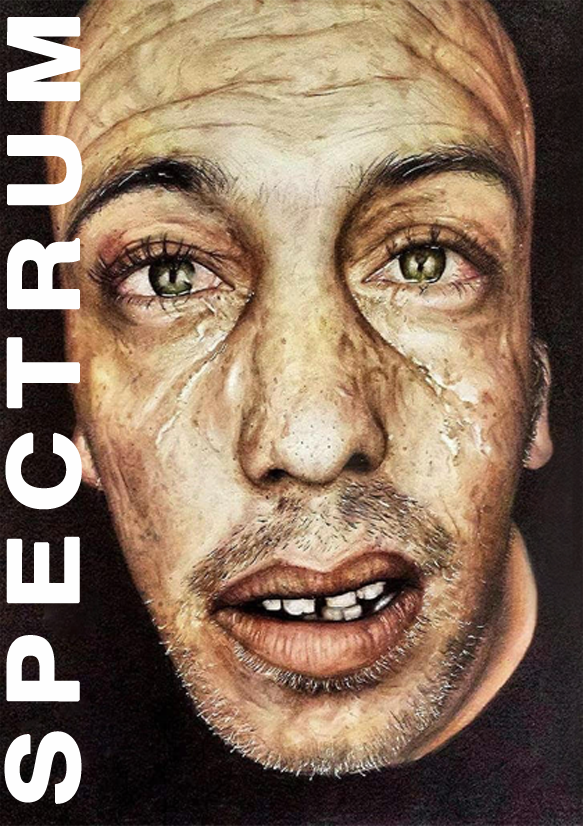
Michelle Nguyen created the art that's featured on the cover of Spectrum vol. 61. Order a copy here to see it in person, and to read the fabulous work of all our contributors.

Q: What was the inspiration behind your painting featured on Spectrum's most recent cover? Is this an image of anyone in particular?

The inspiration behind it was a reflection of hard times we go through as human beings and the pain, loneliness and suffering behind it all. He's reaching out for help in his own way. He is hoping that someone will understand him and let him in. The drawing is of no one in particular. I think he reveals the true inner conflict within himself through his emotions and expressions.

Q: If you could pick one emotion on the man’s face in the portrait, what would it be?

I think it would be pain. There is an underlying pain in his eyes. He beams his emotions through them.

Q: What details did you add that make the image more human? How did you go about deciding on those details?

The details that I added was the scarring tissue on his face. I feel that giving him more texture and scarring will make him look more human. I added them with layer by layer with my color pencils.

Q: Can you talk a little about how asymmetry plays into the painting?

I think the lack of perfection in his face as well as the a symmetry makes him more relatable as a human being. The imperfections make him whole as a person. I wanted to give him a bit of discoloration to add to it all as well.

Q: What do you think makes this piece a good fit for Spectrum? Did you envision this being the cover?

This will make a great cover for the magazine because I think it entails our struggles in a way through our every day life. Life isn't meant to be perfect. It's meant to be lived through our trials and tribulations. The face of my drawing, his scars and all represent for me a journey that we all go through. I actually never envisioned this ended up being the cover and I am absolutely ecstatic and so blessed to have the opportunity to share my work with everyone.

Q: Is this piece typical of your style, or did you go outside your own box a little bit?

This piece is definitely my style. All my portraits are a bit of self reflection of myself. Depending on the time that I am drawing, my portraits are a representation of those times. My thoughts and emotions during that period are what changes my style with each drawing. He was definitely a challenge for me to draw though. To be able to bring out what I felt like he was feeling through his skin and the tears coming down took quite a bit of time for me. The drawing took about 60 hours to do.

Q: How would you say your personal style has developed in the time you’ve been creating art?

Well, I started three years ago. I lost my father and other stuff was happening to me during that period of time. I was really searching for a purpose in my life and also a way to take my mind off everything. Someone had came into my life and influenced me to try to start drawing and I did. It became therapeutic for me. I've never been someone who had an easy way of expressing themselves and I feel like through my art, I actually can. I can tell my story through my work so as I go through my life, I think my style will change depending on the periods in my life. My style mainly focuses on the raw forms of human emotions at the moment but who knows where life will take me next.

Read moreContributor Interview: Michelle Nguyen

Contributor Interview: Andrés Worstell

By Spectrum Staff - November 20, 2018

Andrés Worstell's poem "Ashtray Sermon" is featured in  Spectrum vol. 61. Order a copy here to read it and the fabulous work of all our contributors.


Q: What was your inspiration for “Ashtray Sermon?” How does relate to your own experiences?

If the road is your religion then a dimly lit fast-food joint just off the highway (preferably an Arby’s or a Dairy Queen) is your church; Mass held just after nightfall after a long day of driving and still miles before the promise of a bed, your only companions the voices on the FM and the headlights that disappear in the darkness as quickly as they appear. “Ashtray Sermon” comes from two different aspects of my life: first, my family moved around a bit when I was a kid which meant a good amount of time on the road. I was fortunate enough to grow up experiencing the USA through its truck stops, national monuments, tourist traps, navy bases and burgers. The other aspect I drew from was my time spent working late nights in fast-food (a Subway located at a Marine Corps Air Station to be exact, but that’s a story for another time.) There’s really nothing quite as American as the dull loneliness of consumer society, right? I liked the job ok, though.

Q: How long have you been writing poetry? What is your inspiration most often drawn from when you write?

I have been writing poetry since my senior year of high school. Prior to that, my experience had mostly been in writing lyrics for my punk band Stair Step Kids, which I find to be much easier to write than poetry. When writing lyrics I can fall back on the music to back up the writing, whereas in poetry the words are the music, essentially. When I write poetry I generally write down a series of images that stand out to me or phrases that I find to be interesting until I see some thematic cohesion or theme emerge--or not. Ultimately I tend to be drawn to the mundane aspects of life when I write poetry, as I enjoy describing the humanity within the monotony of existence.

Q: Do you also write prose and, if so, what? If not, why not?

Yes, I mostly write short stories and flash fiction, though I’m currently in the outlining stage for something longer--as is the cliché about writers. When writing poetry I enjoy playing with language and experimenting with style and structure. When writing prose I’m usually interested in conveying a narrative in some respect, though I do enjoy experimenting and tend to gravitate towards the mildly surreal (with a humanist bent,) in the vein of Aimee Bender or George Saunders. Which, I suppose those are two highly emulated writers right there, but hey, steal from the best right?

Q: You are a writing and literature student at UC Santa Barbara’s College of Creative Studies where Spectrum is produced. Why did you decide to major in Writing and Literature in CCS?

My goal for college coming out of high school was to continue to write work I would be proud of while being challenged by modes of writing and storytelling unfamiliar to me, so my work could evolve over time. I figured the Writing and Literature major in CCS would allow me to evolve in the way I desired. And, so far, this has proven true.

Read moreContributor Interview: Andrés Worstell

Contributor Interview: Elena Norcross

By Spectrum Staff - October 31, 2018

Elena Norcross' fiction piece, "Kris," is featured in Spectrum vol. 61. Order a copy here to read it and the fabulous work of all our contributors.

Q: In your short story “Kris,” the protagonist Kristina is tasked with taking care of her boyfriend’s bunnies for his latest startup scheme. She is portrayed as a neurotic, fast-paced woman who does not seem to fit in the life she is living. There are a couple parts where you relate her with wolves, and describe her as having animal like tendencies: characteristics that typically are not used to describe women. Is there a specific reason why you chose to portray her this way? What was the intended effect you were going for by comparing her to wild animals?

It was intentional to portray Kris this way. Why does the lead character have to be likable? Why does a female protagonist always have to be likable? These were some questions that made me start writing "Kris." Women in most societies are expected to be poised, clean and polite to incredible standards. As a woman, I have felt that if I acted in anyway outside of these parameters, I would be alienated by the people around me. Kris is a woman, but also a very intense person dealing with her own personal issues. I wanted to give her animalistic traits, like anti-social behavior or lashing out at containment to highlight even more that Kris was a "different" kind of woman. Probably one most women actually feel like in their hearts: they have needs and wants and probably make compromises to fit our culture's idea of what a woman should feel and act like.

Q: While reading this piece, I expected it to take a supernatural turn, especially at the end. You mention spirits throughout the piece, and Kristina’s resemblance to an animal paired with the feeling of something secret throughout led me to believe she had a supernatural side to her. When you were writing this short story, did you consider adding something supernatural? Or did you just want to create that sense and leave the audience wanting more?

I always seem to have a supernatural or spiritual element to my stories. This probably comes from reading too much Ray Bradbury as a kid! I was raised in the Western part of the country and native spiritualism was something that always interested me. I guess that's why I included the thought of the shaman in the basement, Kris' one moment of thinking she might be punished for her behavior. I also had a mother who loved to tell me ghost stories about her family, so the fantastical always finds its way into my writing!

Q: Can you share what inspired you to write this piece, and a little about your personal writing process (How do you come up with ideas to write about, how long does it take you to finish writing a story, where do you generally start when you have an idea for a story)?

My sister actually inspired this piece. We are twins, but very different. I often think that the way she sees the world is in opposition with how I do. Many of the protagonists' behaviors are taken from my sister. When I wrote this, my goal was to understand her better, as well as my own struggles with anger and self acceptance. Concerning other projects, I write long hand in a notebook with very messy handwriting. My ideas can come from a news story, an old family rumor, or an attempt to highlight issues that I believe are forgotten. I then type it up and edit as I go, which leads to a lot of moving whole paragraphs around! I try to write a short story a week, let it rest and then edit it.

Q: How long have you been writing, and when did you decide writing was a career you would like to follow? Was there a specific moment, or have you always wanted to be a writer?

I've been writing since I was eleven. Of course, I have always been a big reader and I wanted to write stories that I couldn't find in the library. I wrote with pencil in notebooks at first and then started entering my stories into contests. I decided to seriously follow this art after high school when I decided to move from a potential career in dance to focus more on my writing, which was always my first love. People's stories throughout history and even the people around me have always sparked my interest and I guess that's why I write. To understand people and their lives better.

Q: What has been the hardest part of your writing career, and what has been the most rewarding? Do you have any advice for our readers?

The hardest part of my "career" has been trying to get people to understand that even as a young writer (23 years old). I have experience and knowledge that I want to explore with my writing. Being considered "too young" or having nothing to say of substance really grinds my gears. Of course, rejection is a hard part of writing but I've accepted that it comes with this career! Advice? Read a lot. That's how I picked up the rhythm of writing and learned what works and what doesn't. I can't stress enough that writers need to take the time to read. Like I tell my students, improv comedians or jazz musicians don't just pick up a mic or saxophone and go at it. They have to have an understanding of the fundamentals, like how to tell a joke or read notes.


This interview has been lightly edited for length and clarity.

Read moreContributor Interview: Elena Norcross