Image
Computer

Second Impressions

By Vy Duong - June 30, 2021

Spectrum reader Vy Duong writes about her journey to become a creative writer and join Spectrum.

In truth, I’ve wanted to be part of ​Spectrum​ since even before I came to UC Santa Barbara. I remember when I was first accepted — for communication in the College of Letters & Sciences, the biggest of UCSB’s three colleges—I scoured Google for any possibility of taking creative writing courses in college. “​ucsb writing” ​lead me to “​ucsb writing program” ​which lead me to the homepage of the Writing Program which lead me to the Professional Writing Minor before I circled back to two search results down, landing on the Writing & Literature page of the College of Creative Studies (CCS) website and then eventually, ​Spectrum.

At the time, I didn’t even know what a literary magazine was. I came from a Bay Area high school considered to be a UC feeder, where the most interest and money was dedicated to developing our STEM programs, pumping out a mass of computer science majors, med school dreamers and engineer hopefuls. After struggling in calculus, sleeping through chemistry, and loathing my AP English teachers, I figured I’d pursue something in social sciences, something that could translate into business or marketing.

Creative writing was never really on my academic agenda. Sure, I wanted to be a writer when I was in fifth grade, but I had also wanted to be a fashion designer, a lawyer, a spy. Being an immigrant kid, I weigh all my life choices by cost and profit. How do I make an empty glass full? Still, I was excited at the prospect of being able to take a few classes here and there on a hobby I thought I was somewhat decent at. I looked up “​what is a literary magazine​” and was impressed by the answer Google gave me. Then I read through Spectrum’s course description and was delighted to find that I didn’t have to be a CCS student to take it. ​Okay,​ I thought, ​I’ll ask to join Spectrum eventually.

Fast forward almost two years and an ongoing pandemic later, life comes full circle. Every week, I log onto a Zoom meeting and am greeted by familiar faces. For a few hours, we go through our decisions on submissions, discuss what we liked, what we didn’t like, and crack the more-than-occasional jokes in the chat box. Sometimes, the Zoom fatigue lingers, but most of the time, this is one of my favorite courses.

At the beginning of this quarter, I was worried about how unqualified I am to be in this course. Like — who let ​me​ be the judge of what’s good writing? Fiction and nonfiction, maybe I could appraise, but poetry? The only thing I remember about poems is iambic pentameter.

Yet over the course of the past ten weeks, I’ve come to appreciate ​not knowing​ in order to learn something new. The beauty of being in a community of writers and readers like Spectrum (and the CCS Writing & Literature Program at large) is that you are always at risk of learning from someone who knows more than you. I can’t count on one hand the amount of times I have walked into a class meeting with a preconceived notion of a piece only to come away with a completely new perspective.

Being a part of Spectrum has reinforced a lesson I’ve been internalizing for the past two years: to be open to the unexpected. I’d never planned on majoring in Writing & Literature, but the one thing that the pandemic gave me was time to think. Suddenly stripped of my friends and the campus environment that had kept me going, I realized that I wasn’t enjoying my major in a way that made it worthwhile. So I thought about what I had really wanted to do since I was accepted into UCSB—creative writing. I applied to CCS for Writing & Literature at the end of my freshman year and am now two quarters deep into the program. Frankly, I am kind of loving it.

There is that saying I always get wrong. Is it that art imitates life or life imitates art? If the bleak world we’re currently living in has taught me anything, it is that plans can fall apart, diverge, merge into something entirely new. The best I can do is trust my instincts and give every thought a second glance.
Read moreSecond Impressions

Image
Paige Headshot

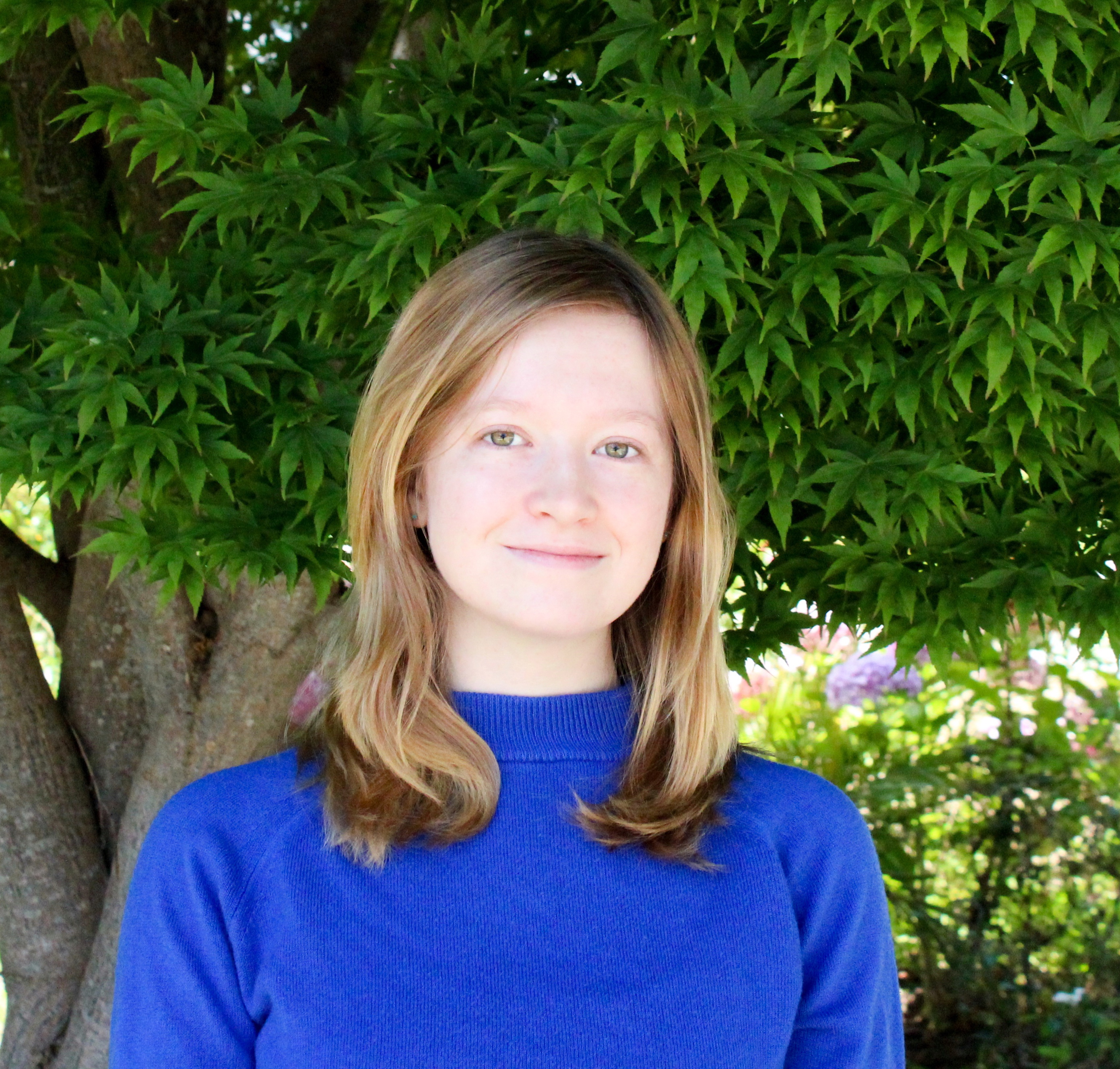
In Conversation with Paige Dixon, Spectrum’s Editor-in-Chief

By Luc Le - June 3, 2021

Spectrum reader Luc Le interviews our editor-in-chief, Paige Dixon.

Now in its 64th year, Spectrum Literary Journal has seen more than its fair share of talented writers, poets, readers, and, of course, editors-in-chief. This year, Spectrum is led by Paige Dixon, a sophomore writing & literature major at UC Santa Barbara’s College of Creative Studies (CCS). I caught up with Paige over Zoom to talk about her plans for the UC system’s longest continuously published literary magazine, and the unique challenges of organizing Spectrum during the pandemic.
This interview has been edited for clarity.

Why did you first get involved with Spectrum?

I was involved in a literary magazine at my high school, and the backstory there is that my high school has very little involvement with creative writing. The school runs from seventh grade to twelfth grade, so I was there for six years, and, in all that time, I had about two creative writing assignments. So what we wanted to do with our literary magazine was provide a platform for creative writers to share their work because we knew that a lot of people were writing, but independently and separately from each other. So we wanted to make this platform to share our creative work and, you know, kind of create a creative community within the school, and it worked out really well, and I enjoyed doing it a lot. So when I came to UCSB and I found out that there was a literary magazine here, I wanted to get involved. Spectrum’s at a much greater scale than my high school one was, and so there's a lot of work to be done for every issue, and I just wanted to help out.

What made you want to become editor-in-chief?

Well, I really enjoyed working on Spectrum my first year—I definitely got a greater appreciation for why literary magazines exist and just what they can do. I think I just enjoyed working on it so much that I wanted to engage with it even more. I actually applied to be managing editor, but then they asked, well, would you be willing to also apply for editor-in-chief? And I said yes, because I had a bunch of ideas I wanted to try out, and they were kind enough to give me the platform to do so. I really wanted to get people more engaged with—to get people more aware of Spectrum [around campus]. Having come from the [College] of Letters & Sciences, I know just how invisible Spectrum could be, and coming from my high school where our literary magazine was so prevalent in the creative community, I was wondering, where is this magazine? Why don't we see it on campus more? And so I wanted to get people more engaged.

What are your typical responsibilities as editor?

There's basically three periods of [the] editorial process. There's [the period] from opening to closing of the submissions, and I just sort of keep an eye on that, making sure things are working out well. And then after the submissions close, we immediately start to process those, get them ready for the readers to evaluate. I love spreadsheets—they’ve been helping me keep track of everything and to assign pieces to the readers, making sure we cover enough in each session to get finished in a timely manner. [The] next [period] is managing the submissions as they go through the editorial process: everyone's going to read some pieces, give feedback on them—we're going to have three rounds of editorial reading. And then we also work on a bunch of things behind the scenes, like with our website and social media.

The big one for me is the budget. We get a yearly amount of funding from CCS, and then
we also have a few other things that we can apply for to supplement that funding, like grants.
Next quarter, when we have expenses, I'll be working with Marianne [Morris], our [financial] coordinator, to get those expenses paid. We’ll design the magazine together, but then I'll be in charge of getting that design printed. The situation has looked really different from how it has in the past, because of COVID, but I've been able to sort of follow in my predecessor's footsteps and just adapt to what we need to our situation. I have to give huge thanks to the editorial team—Hayley Tice and Chloe Schicker, and also Dr. Rebbecca Brown, who’s our faculty supervisor—it really was a collaborative effort to conduct the whole operation over the last few months.

How has organizing the magazine in a pandemic been different from in prior years?

The biggest hurdle that COVID has given us has been mailing copies of the magazine to people who have bought them because we can't do that at all right now. We don't have access to the physical magazines and we also don't have access to the mailers [because campus is closed]. So we can't take orders right now, which caused us a little bit of trouble at the beginning of summer when we had to shut that down. And I anticipate we're not going to be able to mail out until probably next school year, maybe late summer this year. So all those orders that we have for the magazine can't be fulfilled for a while. It's kind of a bummer, but we've had to put orders on hold so that we can prevent any more issues from arising.

Tell me a little about the theme of this year’s issue, “perseverance.” Why was it chosen? How has it shaped this year’s edition?

Last year was actually our first year with a theme, and it was “truth.” And that theme made an amazing issue, but it also made a very heavy issue, as you can probably imagine. And so there actually came a point last year where we were considering, you know, how difficult that issue would be to publish in a world that's just starting to struggle with COVID at an extreme scale. And so we were a little—not concerned, but just aware of how much more emotional labor that issue might provide. But there were important topics that the theme covered, and it wasn't all doom and gloom—there was some beautiful work in there. So this year, when I was thinking of the theme for our issue, I wanted to do something that represented the best part of people during COVID—you know, the strength that is getting us through this. And strength isn't consistent. I think in reality, everyone has their good days and their bad days. I wanted to do something that encapsulated all of that—the overall journey. And this can be applied to many things, not just COVID, because life is still continuing during this pandemic. So I chose perseverance because I thought that that word would bring to mind that core “I will not give in” mentality—no matter what the inspiration behind it was, whether it was strength, or spite, or love, or desperation. And so that was basically the general thought behind it.

What’s the best part about working for Spectrum?

I have to say that this year, I was aware that it might be a struggle to get our student
readers to engage with the journal just because everything was online. And so one thing that's been great this year is that everyone has been really engaged with the pieces and the works, and I think we've had some great discussions. We have a wonderful team because people are so willing to collaborate and willing to discuss, not argue. That was one of the best parts—just being able to explore these pieces together. I always love to hear when someone else interprets something just completely differently than I did—I just think it's fascinating. I think everyone pitched in way more than they were required to, so I just was delighted. And then also just personally, I’ve always loved reading the submissions, seeing the wide range of them and finding some works that you just fall in love with. That's the best part of any literary magazine.

Read moreIn Conversation with Paige Dixon, Spectrum’s Editor-in-Chief

Image
AWP Spectrum Booth

On AWP

By Michelle Politski - April 9, 2019

Spectrum vol. 62 Editor-in-Chief Michelle Politiski shares her experience representing Spectrum at AWP.

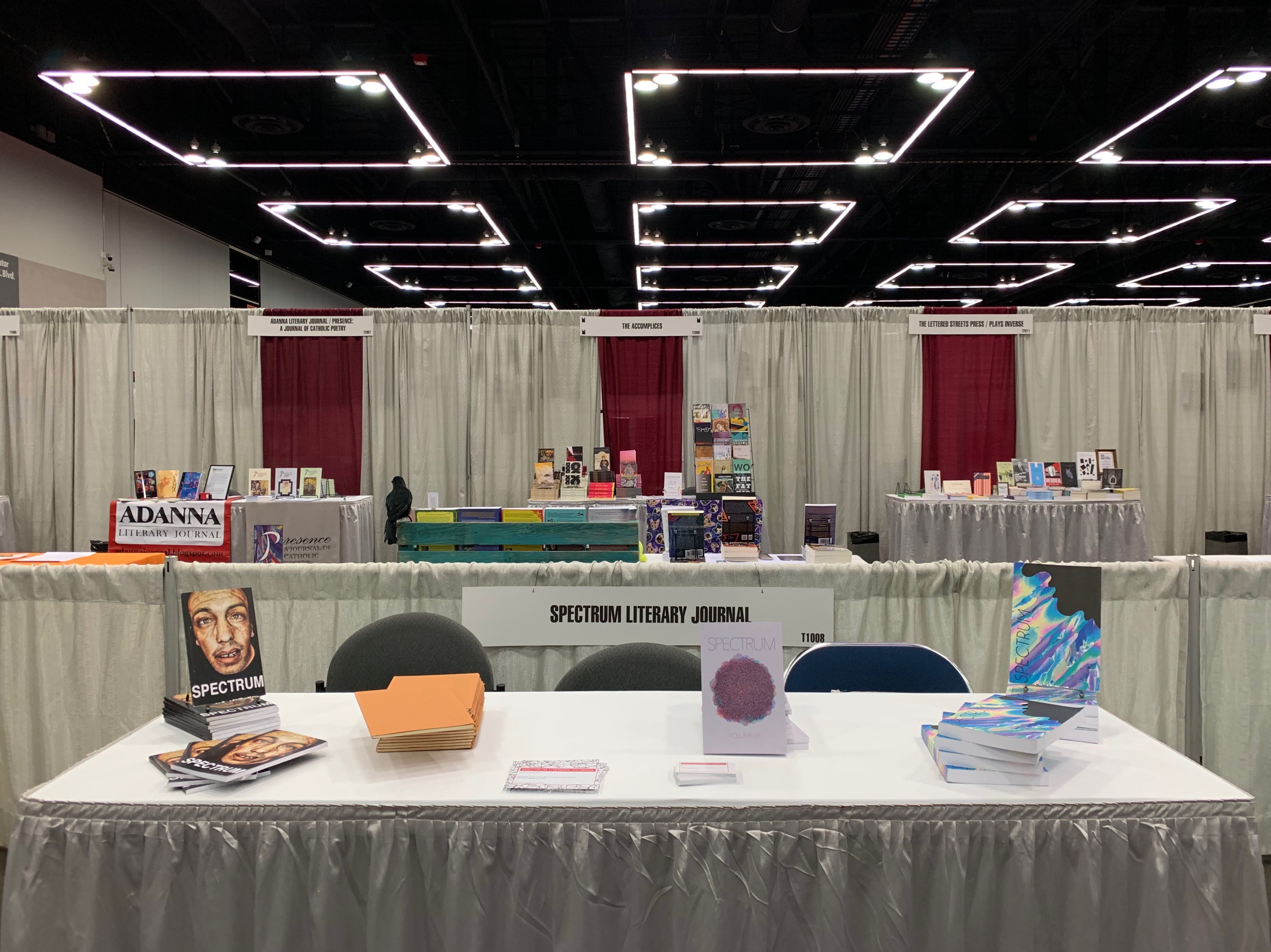
Many writers, small presses, graduate programs, and literary journals make the pilgrimage to the Association of Writers and Writing Programs’ annual conference. In case you haven’t been a part of the literary Twittersphere for long and witnessed the myriad of hashtags, memes, and commentary that takes place there, here’s a breakdown of what it’s like to exhibit at AWP as the Editor-in-Chief of an undergraduate staffed literary journal.

AWP, unlike many literary conferences, has no specific niche in mind; attendees include independent writers of all genres, representatives from various publications and institutions, and the occasional rogue Saturday-only book fair cruiser. Because of some folks’ inherent distrust in the literary taste of undergrads, selling yourself matters.

Undergrad journals as a whole are massively underrepresented at this conference, and for notable reasons. Very few undergraduate-staffed journals have the sort of funding it takes to pay the table registration fee, fly students to an often out-of-state destination, and pay for their lodging and expenses. Spectrum is very lucky to have resources within the College of Creative Studies and the broader UCSB administration that allow us to make this trip annually. With as many grants and fellowships as we were able to be a part of this year, my fellow editors and I were able to make the most of the invaluable AWP experience.

But of course, no amount of funding is ever quite enough funding. As we perused through the book fair upon our arrival to the convention center, we saw that almost every booth or table had shipped their books to the conference ahead of time. There was something uniquely endearing about being among the youngest exhibitors at the conference, searching for our table space in a numbering scheme that made no sense while schlepping a carry-on sized suitcase of journals with one hand and a lukewarm Dutch Bros coffee with the other. If there is anything that characterizes the bootstrap-pulling aesthetic of the undergrad journal experience for me, it was that moment.

AWP is a valuable experience for any writer, small press, or journal. People taking your card, even if they promptly dispose of it when the book fair closes, means something. Spectrum sold a few issues and made a few impressions, but more importantly, we had the opportunity to meet some of our contributors and others with connections who will help keep our journal alive and well. However often the editorial board may change, it’s the people who continue reading our journal and supporting Spectrum that keep the train rolling long after us editors graduate.

Read moreOn AWP

3 Quarters, 1 Issue: The Making of Spectrum Literary Journal

By Shaylie Foley - December 12, 2018

Spectrum reader Shaylie Foley provides an overview of how the journal is made.

Undergraduate literary journals are a major part of the lit-mag community. These specialized magazines are run out of a specific university and are produced regularly--usually annually, but sometimes quarterly or semesterly--by undergraduate students at that university. Spectrum Literary Journal is an undergraduate literary magazine created primarily by UC Santa Barbara students, most--but not all-- of whom are members of the Writing and Literature major within the university's College of Creative Studies (CCS).

At most universities, students who work on the university's undergraduate journal fit the production of the magazine into their schedule like an extracurricular activity. All staff meetings for these magazines are usually coordinated in the evenings or on weekends, when students are not in class. The production process of Spectrum magazine is formulated a bit differently. Students who want to be a part of Spectrum staff are expected to enroll in W&L CS 170, a literary publishing course offered quarterly through CCS's Writing and Literature program. Every step of the magazine's annual production process--from reading submissions for the first time to putting the finishing touches on the journal's final layout--is facilitated through W&L CS 170.

W&L CS 170 becomes a part of each enrolled student's academic schedule just like any other class at the university. It meets at specific, consistent times each week and students' participation earns them units toward graduation on a sliding scale of one to six. The prospect of earning academic units encourages to apply as much effort to their responsibilities at Spectrum as they would to any other academic course and the sliding unit scale allows students to quantitatively declare how much of a role they plan to play in the production of the magazine.

W&L CS 170 is a three-part course series. W&L CS 170A is offered during fall quarter, 170B is offered in winter, and 170C--the last part in the sequential series--takes place during the spring quarter of each academic year. Each of the three courses serves an important purpose in ensuring that the W&L CS 170 series ends each year in the successful production and distribution of a well-organized, high-quality literary magazine.

The first course in the series--W&L CS 170A--focuses on the study of literary magazines as a genre. Throughout the ten weeks of fall quarter, students in 170A are exposed to a wide variety of diverse literary journals ranging from traditional, well-established journals such as The Virginia Quarterly Review to more contemporary, experimental journals like Nat. Brut. This course gives students a chance to better familiarize themselves with the lit-mag genre and are able to get a better idea of how successful, professional literary journals are produced. 170A also includes a study of Spectrum magazine, which helps students who have not previously read or worked on the journal to get a feel for its style and editorial mission.

W&L CS 170B is where editorial decisions are made. The bulk of the course focuses on reading submissions to Spectrum and determining which pieces will be accepted into the final table of contents for the magazine. Throughout this course, students are also expected to produce their own creative work and continue their study of several established literary magazines through assigned readings and class discussions.

The final course in the three-part W&L CS 170 series is 170C, in which students devote themselves to producing the final annual issue of Spectrum in its tangible form. Students' main responsibilities in 170C include line-editing written pieces to polish them before they are published and creating the visual layout and design of the final magazine. The ten-week course ends with the production of a polished issue of Spectrum magazine that is ready for distribution.

Students who enroll in W&L CS 170 are not required to commit to taking all three parts of the course series. Instead, they are given the choice to enroll in one, two, or three of the serialized courses each academic year. This freedom allows students to choose the level of commitment they want to apply to working on Spectrum throughout the year and gives them the chance to participate in only the parts of the production process that interests them.

As a series, W&L CS 170 affords students the opportunity to embark on a year-long journey that introduces them to different styles of literary journals, offers them guidance on improving their skills in editing and submitting to lit mags, and allows them to gain hands-on experience as an editor and writer through the final production of Spectrum journal's annual issue. The independent focus of each individual course in the three-part series allows students to apply their efforts where their interests lie, whether that be in objectively studying the literary journal genre, reading and critiquing massive amounts of raw creative work, intensive line-editing, layout design, or all of the above.

The organization of Spectrum magazine's production into a three-part course series helps ensure the commitment of all staff members at all times both by awarding students academic units for their participation and by giving students the chance to involve themselves in the production of a literary journal by contributing their unique skills and talents to the part of the process where they fit best. This customizable, personalized process allows students to increase their knowledge of the production of literary journals and the literary journal genre itself in ways that truly pique their interest, which in turn widens the contemporary lit-mag community and yields a quality magazine produced with passion every step of the way.

Read more3 Quarters, 1 Issue: The Making of Spectrum Literary Journal

Image
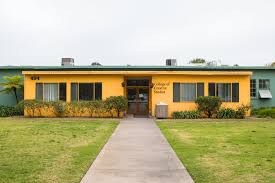
CCS Building

On CCS

By Madeleine Almond - November 7, 2018

Spectrum's current Managing Editor Madeleine Almond shares her interpretation of UC Santa Barbara's College of Creative Studies.

Readers of Spectrum, upon opening the journal and reading “created by the College of Creative Studies at UCSB” will probably ask themselves, “What is the College of Creative Studies?” About half of UCSB doesn’t know. Those who do often give a shallow and unhelpful answer; “the smallest of three undergraduate colleges at UCSB.”

Physically, the College of Creative Studies is building 494 on campus. It was a temporary marine base assembled during World War II and never taken down. Originally, it was severe and proper and without character, but now the office building is painted sunshine yellow, the main building forest green, and the Little Old Theater--donated to the college by the theater department--is a subdued red. Approached from the side, one would mistake it for a small art building (the Sculpture yard takes up a large portion of free space), and from the front, the shock of color makes people stare.

Inside the CCS building is an eclectic and muddled space; an amalgamation of physics, math, computer science, biology, chemistry, art, music, and writing and literature all trying to coexist. These students are already involved in research or creating their own original work. All students at CCS are expected to produce something during their four years at the college. It’s an accelerated college for undergraduates taglined “The Graduate College for Undergraduates.”

On the walls, posters on quantum computing and cancer tissue compete for space with advertisements about musical performances, lectures, and numerous clubs. The bulletin boards are covered in flyers. The whiteboards in the lounge and classrooms are subject to the whims of the students; they adorn them with everything from cartoons to calls for submissions to lists of resources for food and tuition aid. In the hallway is the Train of Thought which has ceased to run due to breaks in the model tracks. A timeline of events leading up to and including the assent of the whole college into a higher state of existence in 2006 extends overhead. There is a computer lab with a printer named Apricot, a piano in room 143, and a small exhibition room that is filled with intense, strange artwork.

In the morning, the building houses the early risers: writing and literature students meeting to discuss prompts and read short stories; artists working tirelessly on their pieces. At night, late at night, the physics and math majors band together to lament their struggles against equations that no longer contain any numbers. The rooms with no whiteboards become refuges for biology and chemistry students memorizing chemical formulas. The Little Old Theater becomes the site of rowdy rehearsals for student-written musicals. Writing and Literature majors can occasionally be found here as well, utilizing the brain’s peculiar ability to enhance creativity as exhaustion increases.

The CCS Building is more alive than any other man made structure can be. It is never empty and never without motion. It’s this frenetic place that supplies its 400 students with the energy and guidance to take on the rest of their college careers.

But the true answer to the question “What is CCS?” is this: CCS is a college dedicated to allowing students to explore and create their own work and express their creativity. Since the founding of the college with its first major, Writing and Literature, these creative endeavors included the publication of a literary journal by the undergraduate students. Spectrum is still published by the Writing and Literature students today.

Read moreOn CCS

My Editorial Mission

By Kailyn Kausen - June 13, 2018

Someone who comes across the history of Spectrum might wonder why a journal that used to publish greats such as William Carlos Williams, Samuel Beckett, and Raymond Carver is altering its mission statement now, as we produce our 61st Volume. As the editor-in-chief, I wrote the new mission statement, so let me tell you about who we used to be and what we are trying to become.

As the title Spectrum suggests, we publish a spectrum of things. This used to be just a spectrum of voices, yet we’ve always had in our mission statement that we will publish "anything printable in 2-D." When re-evaluating our journal, we thought to take this one step further, questioning what "anything in 2-D" really means.

I looked at that our old statement, thought about it and wrote it on my bathroom mirror in purple lipstick to make myself see it a different way. And I thought, why haven’t I seen poems written in lipstick on a mirror represented as poetry or art or a hybrid rather than just photography?

So we evolved from publishing a spectrum of voices to publishing a spectrum of everything. And when I say everything, I mean everything. Hit us with anything – the weird, the funny, the out there, the things that make you wonder if this idea is genius or stupid. We want to give a voice to not only traditional works, but also works that might not be considered publishable because they are on the fringe of what others deem acceptable as literature.

Volume 61, which launched on Friday, June 8th, is a great representation of where we are heading as a publication. This volume includes not only high-quality works of fiction and poetry, but a comic, abstract art, and even work that extends beyond the confines of the print journal. We will be publishing a serialized version of Lee Huttner's "The Wrecking Ground" here on the brand-new Spectrum Literary Blog.

Experiment with form, language, and content. Send us sheet music or a comic strip. Send us erasure poetry or a crossover of art and poetry. Send us a short story that includes images, or genre fiction. Send us an instruction manual or a to-do list. A scientific diagram, a receipt, the image of a tattoo. An annotated image. A short screen-play or script.

Show us how you think about literature differently and how it can be taken to a new level while maintaining a high level of quality and interest.

As a writer who likes playing with experimental concepts, I recognize the lack of available places for publication of strange and different pieces. Work like mine and other more experimental work is out there and deserves a place to be represented. We will be one of those places.

This is a journal run by undergraduate students. It may seem insane for me to try and pull this journal into a bit more of an eccentric and possibly playful direction when I can only work on the journal for a short amount of time. But, I am confident this will be a lasting message that editors after me will embrace and grow with their unique ideas and perspectives.

Kailyn Kausen served as editor-in-chief of vol. 61 of Spectrum.

Read moreMy Editorial Mission